‘Life, Larry and the Pursuit of Unhappiness’ Review: Larry David Turns American History Into a Very Familiar Complaint

Photograph by John Johnson/HBO
Larry David and Jeff Schaffer’s HBO sketch series has flashes of inspired historical absurdity, but its ‘Curb Your Enthusiasm’ formula starts repeating itself long before the season ends.
Larry David has spent decades turning minor irritations into moral crusades. The genius of ‘Curb Your Enthusiasm’ was never simply that Larry was cranky, rude or socially impossible. It was that his grievances often contained a tiny, uncomfortable kernel of truth. A bad line-cutting policy, a misused phrase, a social nicety extended past its expiration date, a dinner-party custom nobody wants to admit is absurd — David’s comedy has always worked best when his character’s total lack of tact collides with the fact that he may, technically, have a point.
‘Life, Larry and the Pursuit of Unhappiness’ tries to extend that worldview across American history. Created by David and longtime collaborator Jeff Schaffer, the seven-episode HBO limited series drops a Larry David-esque figure into various historical moments, reimagining the nation’s past through the lens of petty complaint, social friction and institutional absurdity. On paper, it is a strong comic premise: what if the same man who could not survive a dinner party without starting a feud had been present at the drafting of the Declaration of Independence, the back rooms of political scandal or the mythology of presidential history?
In execution, the series is entertaining in bursts, occasionally very funny and far too often content to repeat a joke structure that worked better when it was attached to modern life. The show’s central comic engine is clear almost immediately. A familiar historical moment begins to unfold, Larry arrives with an unrelated grievance, the grievance derails the event, and the sketch either finds a clever collision between past and present or simply becomes ‘Curb’ in period costume. Sometimes that is enough. More often, the idea wears thin because the series mistakes recognition for escalation.
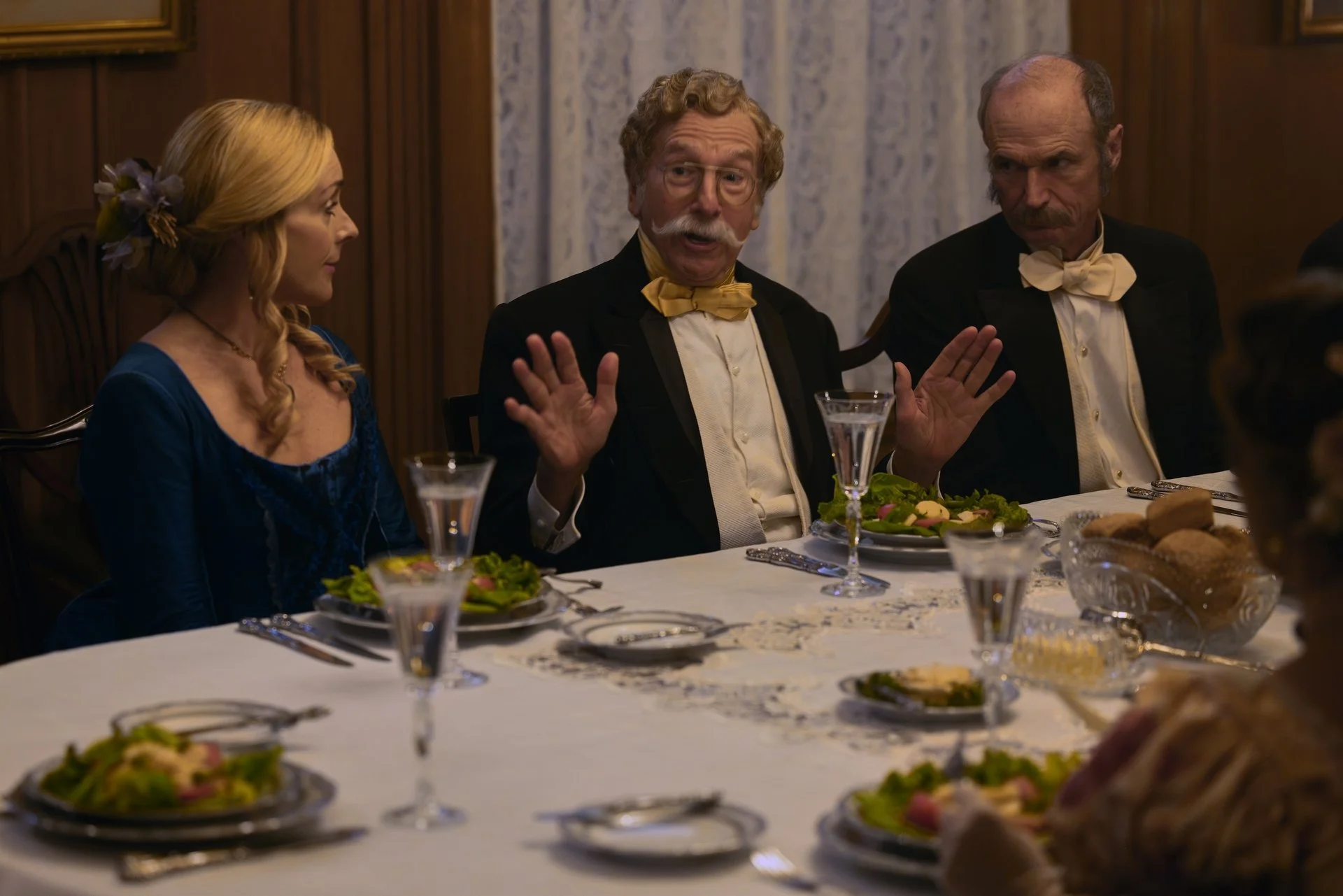
The first episode establishes the pattern with David appearing as Robert Livingston during the drafting of the Declaration of Independence, where his complaints extend beyond King George III into the kind of everyday social codes that would not be out of place in a ‘Curb’ cold open. There are jokes about lines, customs, etiquette and the acceptable time frame for saying “Happy New Year.” Some of it lands because David still has a unique gift for making irritation feel philosophical. But the sketch also makes clear how much of the series will depend on transplanting already familiar Larry David fixations into older settings.
Photograph by John Johnson/HBO
That familiarity is both the show’s appeal and its limitation. Viewers who miss ‘Curb’ may enjoy seeing David return to recognizable rhythms: the incredulous stare, the escalating objection, the unwillingness to let a minor point go, the total confidence that everyone else is wrong. But ‘Life, Larry and the Pursuit of Unhappiness’ often feels less like a reinvention than a remix. Several bits are direct echoes of earlier ‘Curb’ material, including references to “Respect Wood,” “Chat ‘n’ Cut” and the inevitable “pretty, pretty good.” What begins as self-homage eventually starts to feel like a show openly recycling its own muscle memory.
The sketch format does not always help. ‘Curb Your Enthusiasm’ worked because its comic logic had time to trap Larry inside the consequences of his own behavior. One grievance would intersect with another, then another, until an entire episode collapsed into a beautifully engineered social disaster. Here, most sketches have to establish a historical setting, introduce the guest stars, explain the premise, deliver the Larry complaint and exit before the idea has much room to compound. The result is a series that frequently feels like it has punchlines but not enough architecture.
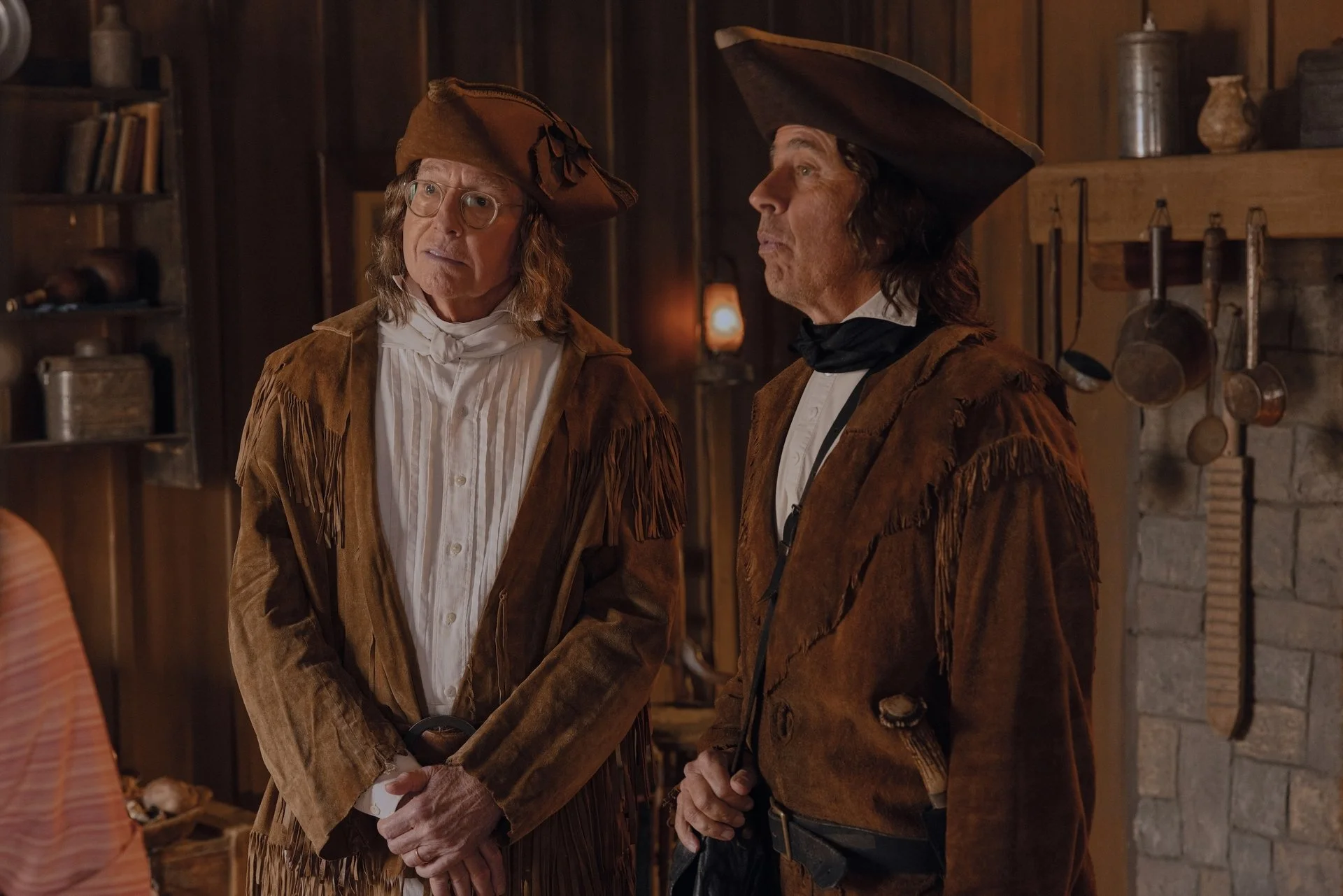
There are exceptions. One Abraham Lincoln-centered sketch stretches across most of an episode, giving the premise more time to develop and allowing the jokes to build with a patience the shorter pieces often lack. A riff on ‘All the President’s Men’ works better than expected because it commits to a more specific cinematic style, letting Schaffer lean into a gritty, 1970s conspiracy-thriller texture rather than defaulting to stagey historical cosplay. The best sketches understand that the joke cannot simply be “Larry David was there.” They need a second layer, a formal twist or a specific historical irony to make the collision feel worth revisiting.
That is why the series’ Trump-era material, even when not especially hilarious, at least has a pulse of anger. David’s comic persona has always been more effective when annoyance shades into moral outrage, and those sketches benefit from feeling rooted in something stronger than clever placement. The show is at its weakest when history functions merely as a backdrop for grievances that could have been staged at a country club, a restaurant or a doctor’s office. If the period detail does not sharpen the joke, it becomes decoration.
Photograph by John Johnson/HBO
The guest cast helps considerably. Bill Hader is the standout, bringing the kind of elastic comic energy that makes him seem capable of matching David’s rhythm for hours. Kathryn Hahn is excellent, which is hardly surprising, and she brings real texture to material that could have been flatter in less assured hands. The series also leans on familiar David-world collaborators, including Jerry Seinfeld, JB Smoove and Susie Essman, whose presence gives certain sketches the comfortable feeling of a reunion. Jon Hamm, as always, knows exactly how to make a comedy cameo feel effortless.
Still, many guest appearances produce exactly the reaction one would expect. The performers are funny because they are funny people, but the show rarely surprises us with them. Too often, the casting does more work than the writing, and the writing settles for the pleasure of seeing a recognizable comic actor dropped into a recognizable historical conceit. That pleasure is real, but it is not always enough to sustain seven episodes.
Barack Obama’s involvement is the series’ strangest and most intriguing element. As an executive producer alongside Michelle Obama, he appears early as a kind of framing presence, suggesting that the show might use him as a wry historical guide. Then he largely disappears before returning more directly later in the season. When he is onscreen, his comic timing is genuinely sharp. Whatever one thinks of his politics, Obama understands rhythm, underplaying and the value of a pause, and his presence briefly gives the series a different kind of charge. The show never quite figures out how to use him structurally, but his appearances are among the more memorable pieces of the season.

Photograph by Courtesy of Art Streiber/HBO
Thematically, ‘Life, Larry and the Pursuit of Unhappiness’ gestures toward the idea that American progress has always been messy, uneven and shaped by irritation as much as idealism. That is a funny enough organizing principle, and it fits David’s worldview. But the series rarely pushes far enough into that idea to become more than a sketch exercise. The best historical comedies use the past to expose the present. This one sometimes does that, but it is just as likely to use the past as a new place for old complaints.
POPULAR ON THE CINEMA GROUP
That is not fatal. There are laughs here, and David remains a singular comic presence. His timing, phrasing and refusal to soften his persona continue to generate pleasure, even when the material is second-tier. Schaffer directs with enough pace to keep the episodes moving, and the series is never so long that its weaker sketches become unbearable. At its best, the show feels like a clever expansion pack for the Larry David universe, full of moments that fans will quote, share and rank against one another.
But as a full season, the repetition is hard to ignore. The premise starts clever, becomes formulaic and then occasionally recovers when a sketch breaks away from the expected shape. That unevenness makes the series feel less like a bold new chapter for David than a historical detour with a few worthwhile stops. For viewers who still find Larry’s grievances irresistible, the show will deliver enough amusement. For anyone hoping this format might reveal a surprising new side of his comedy, the pursuit may end in mild disappointment.
‘Life, Larry and the Pursuit of Unhappiness’ is not a failure. It is too professionally made, too well-cast and too intermittently funny for that. But it is also not the full comic reinvention its premise suggests. It turns American history into another Larry David argument, and while that can be pretty, pretty good in the moment, seven episodes prove that even the best complaints start to lose force when history keeps repeating itself.
RATING: ★★★☆☆
That’s a Wrap
|
Life, Larry and the Pursuit of Unhappiness
|
That’s a Wrap | Life, Larry and the Pursuit of Unhappiness |
“Larry David’s historical sketch series has funny highs and a terrific guest cast, but too much of ‘Life, Larry and the Pursuit of Unhappiness’ feels like ‘Curb Your Enthusiasm’ jokes dressed up in period clothes.”
CREDITS
Release Date: Friday, June 26
Stars: Larry David, Barack Obama
Creators: Larry David and Jeff Schaffer
Network: HBO
Streaming on: Max
Rating: TV-MA
Watch The Trailer Below:


| FEATURES | INTERVIEWS | REVIEWS | The Catalogue | TRENDING | TRAILERS | VIDEOS |










![WERWULF - Official Trailer [HD] - Only In Theaters Christmas](https://i.ytimg.com/vi/cmjpadVj-Vk/hqdefault.jpg)