‘Propeller One-Way Night Coach’ Review: John Travolta’s Nostalgic, Bizarre Directorial Debut Is a Surprisingly Tender Mid-Century Daydream
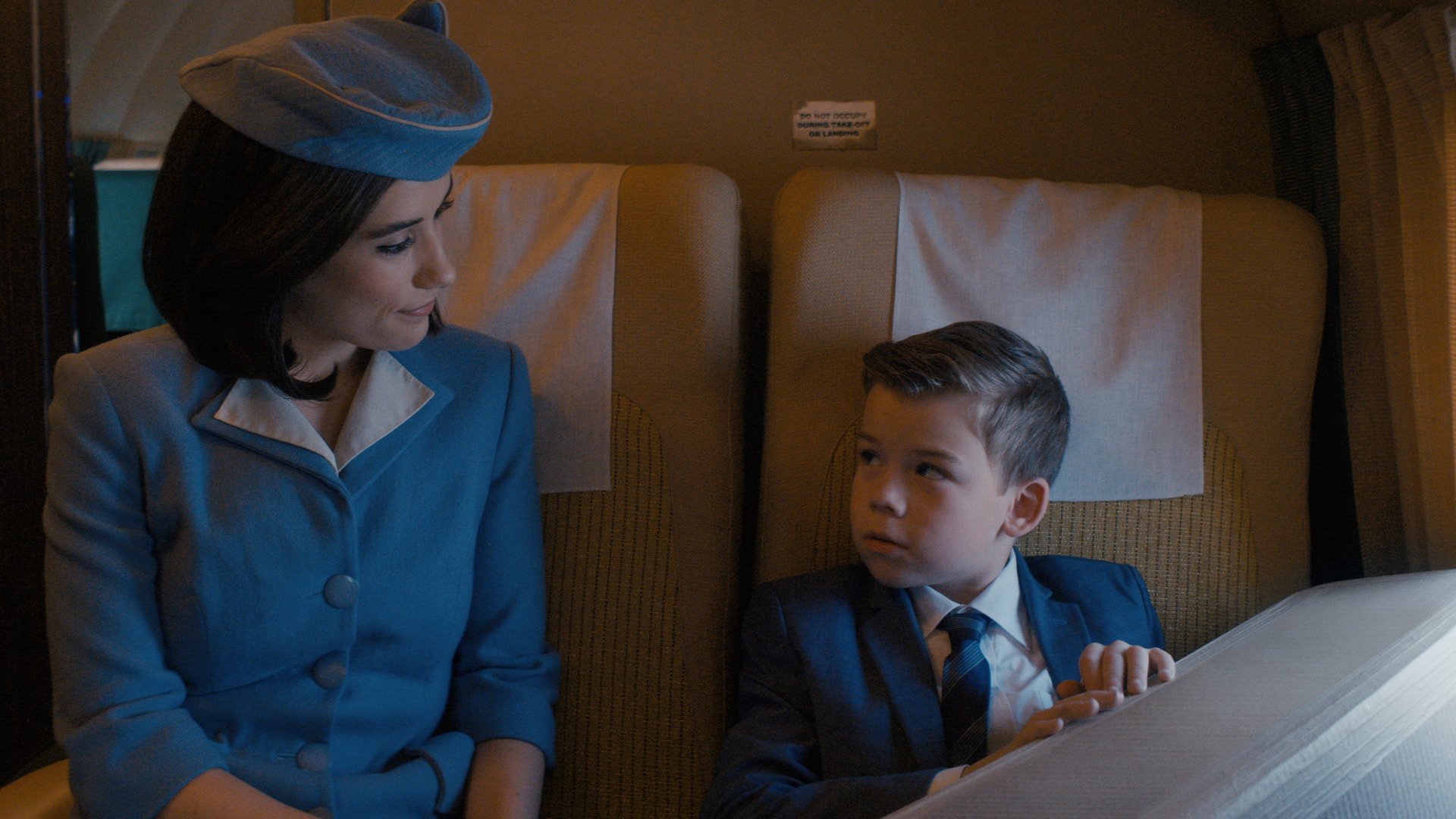
Ella Bleu Travolta and Clark Shotwell in "Propeller One-Way Night Coach," now streaming on Apple TV.
John Travolta writes, directs, and narrates a deeply personal aviation fantasy that is equal parts whimsical nostalgia, family project, and oddly hypnotic cinematic detour.
What would a film look like if it were built entirely out of memory — not just recollected moments, but the emotional texture of remembering itself? Propeller One-Way Night Coach, John Travolta’s directorial debut, attempts exactly that, and the result is something strangely delicate, occasionally bewildering, and unexpectedly sincere.
Premiering in Cannes’ official selection out of competition, the hour-long Apple-backed film is adapted from Travolta’s own 1997 novella and functions less like a conventional narrative and more like a guided reverie through mid-century air travel. Set in 1962, it follows 10-year-old aviation-obsessed Jeff (Clark Shotwell) on a cross-country journey from New York’s Idlewild Airport to Los Angeles, traveling with his mother Helen (Kelly Eviston-Quinnett), a glamorous but emotionally opaque figure navigating her own private detours along the way.
From its opening moments, the film announces its priorities: texture over plot, atmosphere over momentum, nostalgia over narrative urgency. Travolta, who writes, produces, directs, narrates, and even appears briefly on screen, constructs the experience like a museum piece that has been left gently humming in motion. Airplanes gleam with almost fetishistic precision. Cabin interiors are lit like stage sets. Every detail — from airline liveries to wallpaper patterns — feels selected not for realism, but for emotional recall.

Clark Shotwell and Kelly Eviston-Quinnett in "Propeller One-Way Night Coach," now streaming on Apple TV.
The story itself is deliberately slight. Jeff’s journey is not about destination or transformation so much as observation. He is a child absorbing the rituals of travel for the first time, marveling at sleeping berths, meal trays, stewardesses, and the shifting geography of America beneath him. His mother, meanwhile, remains just out of reach emotionally — present, but never fully legible, drifting through stopovers and hotel rooms with a kind of soft detachment that the film never fully explains.
Travolta’s decision to narrate the film himself becomes one of its defining formal choices. The voiceover is constant, often detailing Jeff’s internal reactions in precise, sometimes overly explicit language. At times, it borders on instructional, describing emotional states that the images already communicate. Yet there is also something intentional in this redundancy — as if the film is insisting on the act of remembering twice: once through image, once through language.
What gives the film its unexpected warmth is not its structure, but its casting and self-contained world-building. Clark Shotwell’s performance as Jeff is quietly grounded, avoiding precocity in favor of a natural, wide-eyed curiosity. He does not perform nostalgia; he simply inhabits discovery. Around him, the film is populated by Travolta’s own family members, including daughter Ella Bleu Travolta as a stewardess and several relatives in supporting roles. Far from feeling like stunt casting, the effect is oddly communal, like a home movie scaled up to cinematic proportions.
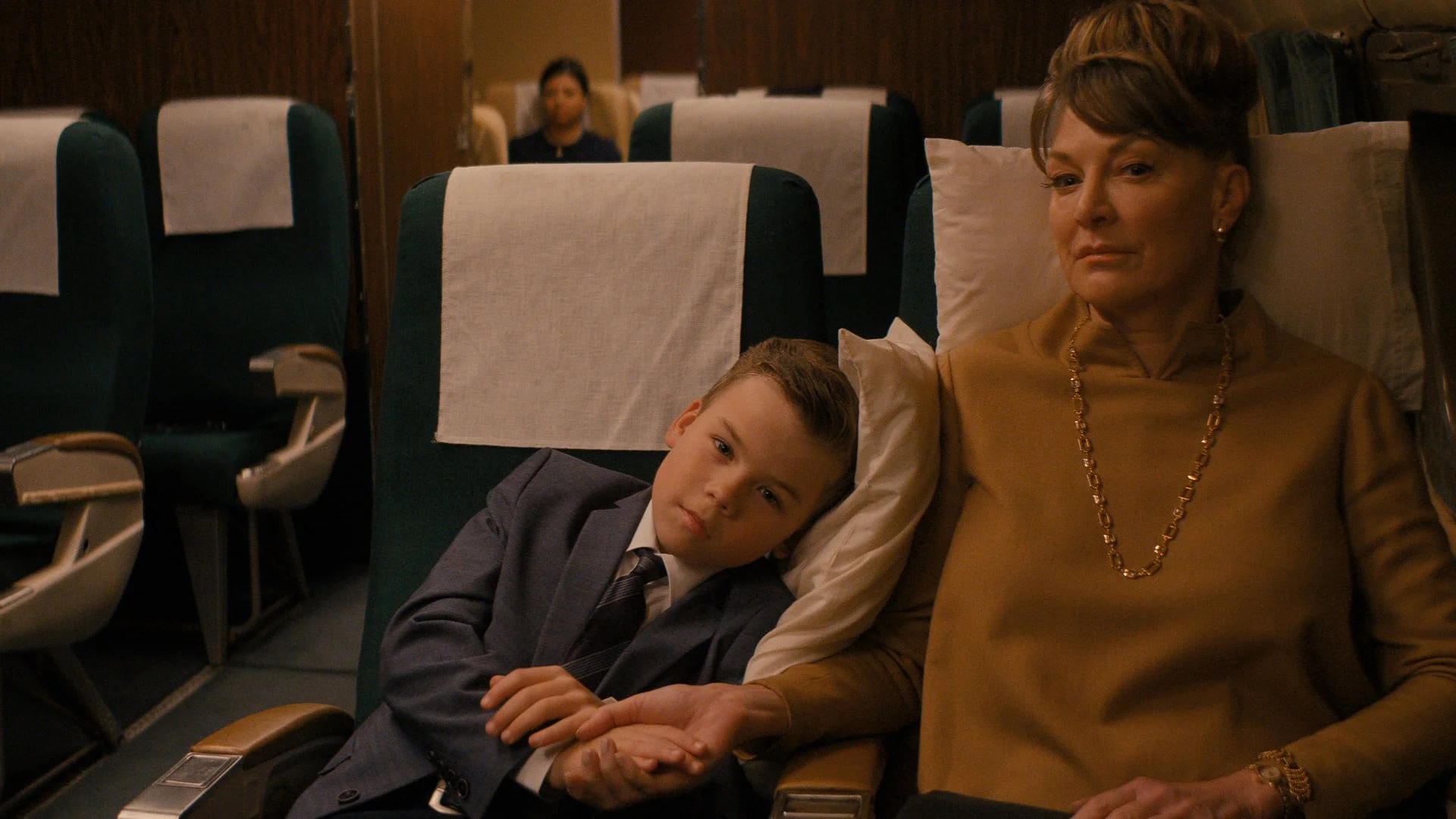
Clark Shotwell and Kelly Eviston-Quinnett in "Propeller One-Way Night Coach," now streaming on Apple TV.
Kelly Eviston-Quinnett’s Helen is particularly intriguing — not fully developed in conventional dramatic terms, but carefully observed in fragments. She exists in glances, interruptions, and unexplained absences, including a brief nighttime detour during a stopover that hints at a larger emotional life the film refuses to fully articulate. These gaps are not quite narrative omissions so much as deliberate refusals to over-define character psychology.
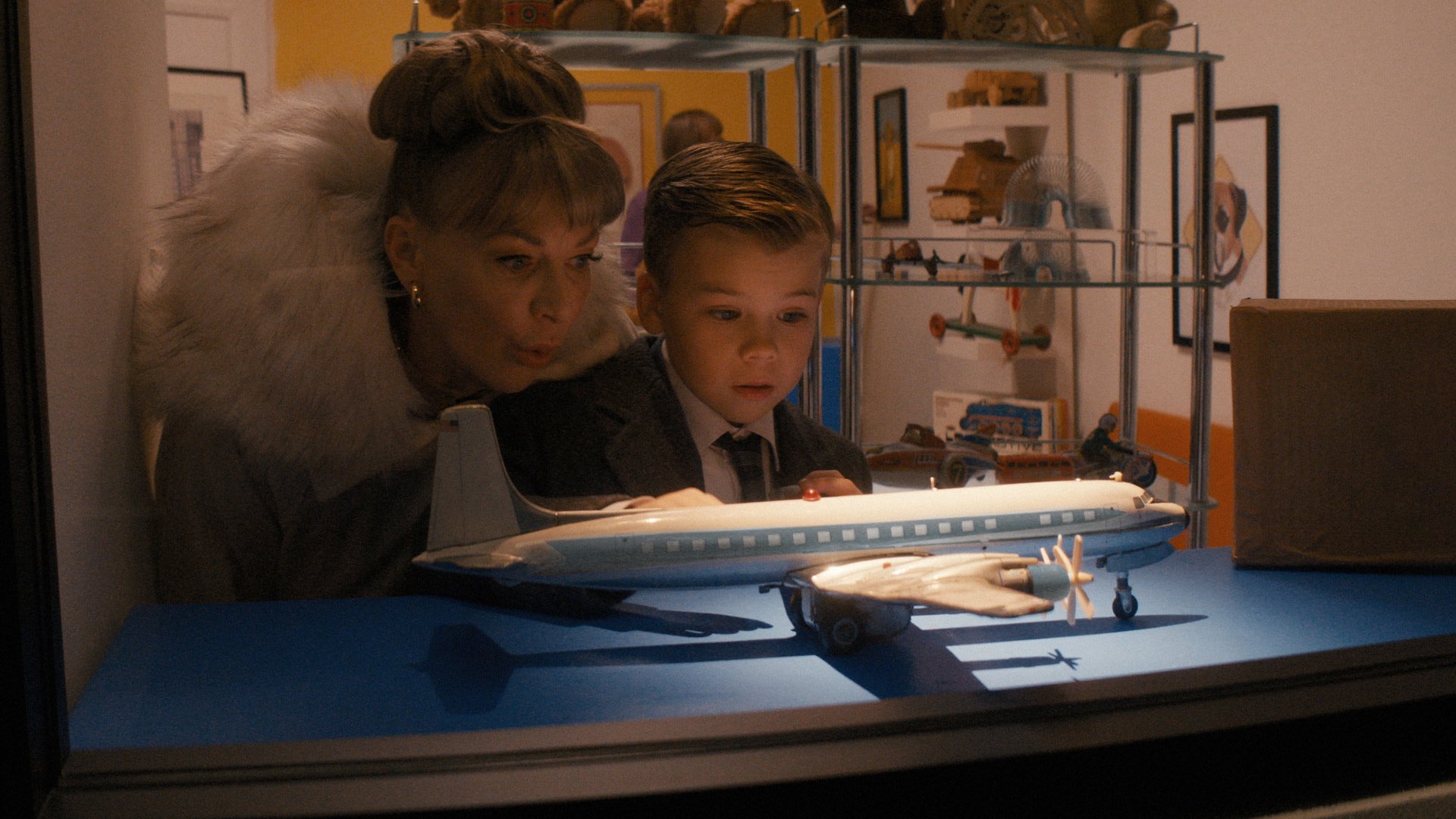
Travolta’s fascination with aviation history becomes the film’s emotional engine. The transition from propeller aircraft to the 707 jet is framed almost mythically, not as technological progress but as a symbolic shift in time itself. When Jeff experiences his first glimpse of a jet plane, the moment is treated as a revelation — less about transportation and more about the feeling of entering the future.
That sense of temporal suspension is reinforced by the soundtrack, which leans heavily into period-appropriate cues, including Frank Sinatra’s “Come Fly With Me” and other era-defining selections. At times, the music selection is so overt it risks becoming on-the-nose, but it also contributes to the film’s larger aesthetic: an America remembered through curated sound, polished surfaces, and idealized motion.

Clark Shotwell in "Propeller One-Way Night Coach," now streaming on Apple TV.
If there is a limitation to Propeller One-Way Night Coach, it is its refusal to expand beyond its own sensibility. The film is not interested in traditional dramatic escalation, and viewers expecting narrative development may find its hour-long runtime more observational than evolving. Yet that same restraint is also what makes it coherent as a personal work. This is not a story attempting to be universal; it is a memory insisting on being preserved exactly as it is.
Travolta’s presence as narrator and occasional on-screen figure further complicates the film’s perspective. It is both inside and outside the story — a remembered experience filtered through adult interpretation while still insisting on childlike wonder. That duality gives the film its most interesting tension: the push and pull between innocence and hindsight.
In introducing the film at Cannes, Travolta emphasized its deeply personal origins, describing it as a story he felt only he could properly translate from page to screen. That sense of authorship is unmistakable. Every frame feels curated, not merely directed, as if assembled from a private archive of aesthetic memory rather than constructed for conventional storytelling impact.
POPULAR ON THE CINEMA GROUP
What emerges is a film that resists easy classification. It is too short and structurally loose to be a conventional feature, too stylized to be documentary, and too personal to function as standard fiction. Instead, it exists in a hybrid space — part nostalgia piece, part experimental memoir, part cinematic scrapbook.
There is a quiet sincerity running beneath its eccentricities. For all its indulgence in design, travel fantasy, and family participation, the film is ultimately about attention — about what a child notices when the world is first expanding beyond the confines of home. That focus gives the project a gentleness that lingers, even when its structure drifts.
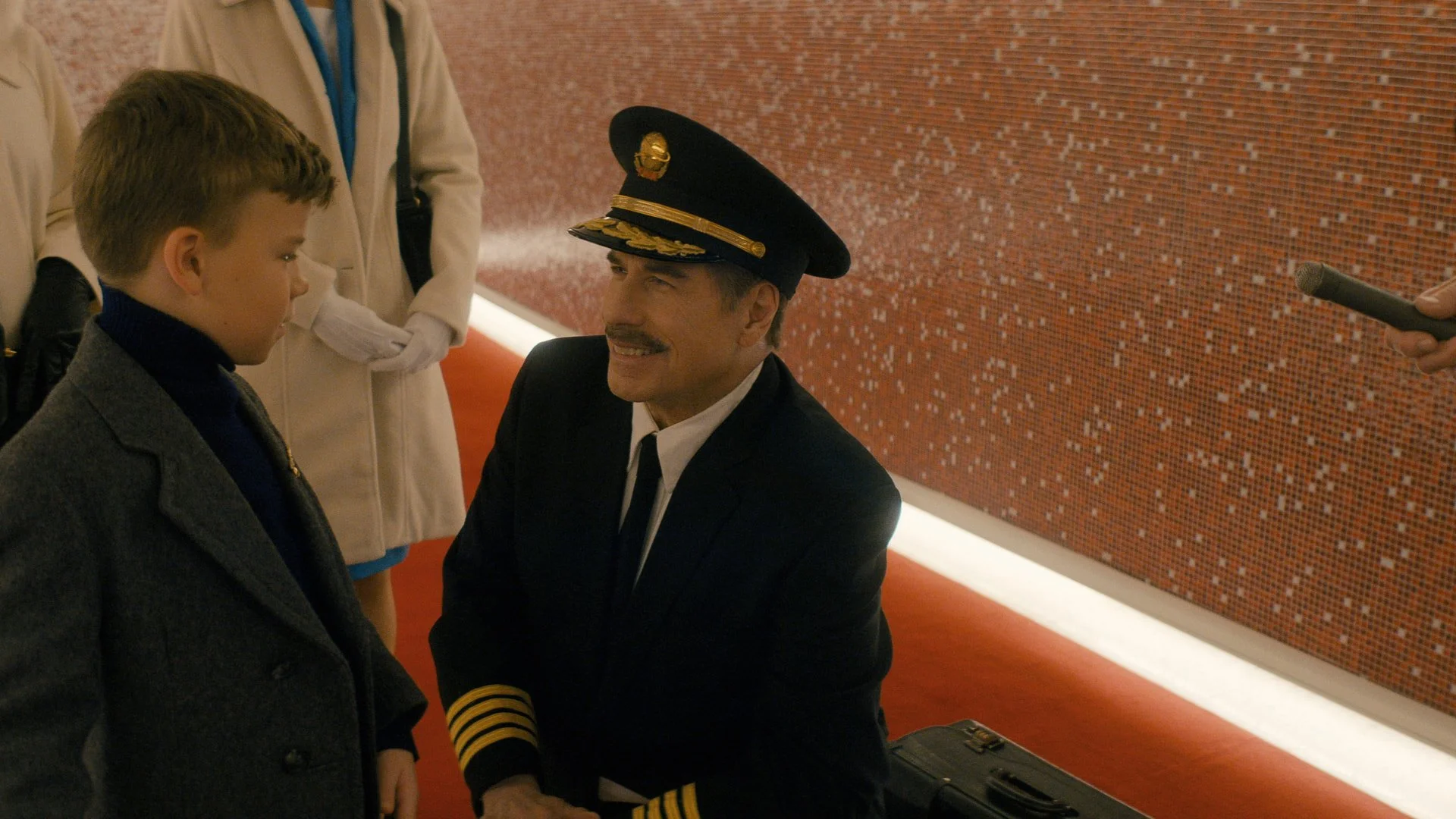
Clark Shotwell and John Travolta in "Propeller One-Way Night Coach," now streaming on Apple TV.
By the time Jeff’s journey concludes, the emotional takeaway is not resolution, but sensation: the feeling of movement through time, space, and memory without the expectation that all of it must resolve into meaning. It is a film more interested in preservation than explanation.
And in that sense, Propeller One-Way Night Coach succeeds not as a traditional debut, but as something more specific — a personal artifact presented as cinema, inviting the audience not to follow a story, but to inhabit a recollection.
Rating: ★★★★☆
THAT’S A WRAP
|
Propeller One-Way Night Coach
|
THAT’S A WRAP | Propeller One-Way Night Coach |
“Propeller One-Way Night Coach is a strange, delicate, and genuinely unique piece of filmmaking that feels less like a traditional narrative and more like a preserved memory unfolding in real time. Even halfway through, it’s clear Travolta is working from a deeply personal place, and while the structure drifts, the tone, detail, and sensibility keep it compelling throughout.”
CREDITS
Release Date: May 29,2026
Cast: Clark Shotwell, Kelly Eviston-Quinnett, Ella Bleu Travolta, Olga Hoffman, Charlie Berger, Margaret Travolta, Ellen Travolta, John Travolta
Director/screenwriter: John Travolta
Streaming: Apple TV
Run time: 1 hour 1 minute
Watch The Trailer Below:

| FEATURES | INTERVIEWS | REVIEWS | The Catalogue | TRENDING | TRAILERS | VIDEOS |








![WERWULF - Official Trailer [HD] - Only In Theaters Christmas](https://i.ytimg.com/vi/cmjpadVj-Vk/hqdefault.jpg)