

The Letterboxd sale is nearing, and its next owner decides if film’s last big independent community survives.
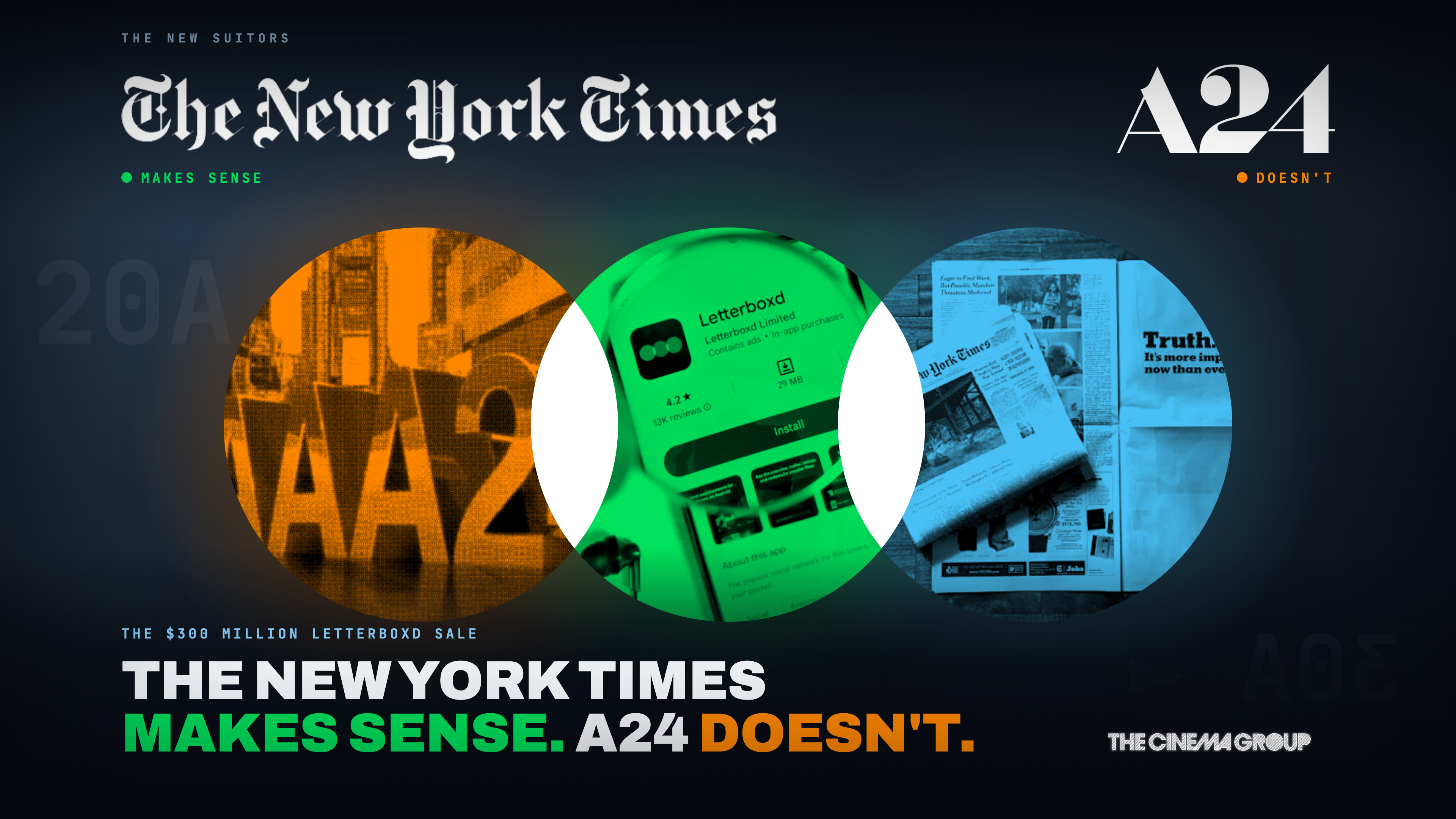
The Letterboxd sale is getting closer, and the list of suitors just got more interesting. The New York Times and A24 have both circled the film community platform in recent weeks, according to reporting from the Times itself. They join a field that has included Sony Pictures, Paramount, Netflix and Versant at various points this year. A deal could value the company at around $300 million.
That is a steep number. Letterboxd reportedly brings in about $15 million a year in revenue, which puts the asking price near 20 times sales. It is also five to six times what the company was worth in 2023, when Canadian holding company Tiny bought a 60 percent stake at a valuation of $50 million to $60 million. Co-founders Matthew Buchanan and Karl von Randow still hold the remaining 40 percent.
In July, we made the case that a studio buying Letterboxd would be a mistake. The platform works because it feels independent, and a studio owner would spend every day proving it was not putting a thumb on the scale. Nothing in the last two months has changed that argument. What has changed is the field.
What the Letterboxd Sale Debate Keeps Missing

Here is the part of the conversation that gets skipped. The film industry’s other big scoreboards already belong to companies with skin in the game.
Rotten Tomatoes sits under Fandango, which is owned by Versant, the Comcast cable spinoff that reportedly held its own talks to buy Letterboxd in the spring. IMDb has belonged to Amazon since 1998, and Amazon now runs a full studio in Amazon MGM Studios. Metacritic has been part of Fandom since 2022.
So the principle that film scores should not be owned by companies that sell films has already been lost at Rotten Tomatoes and IMDb. Audiences mostly shrugged. Expect every studio bidder in the Letterboxd sale to make exactly that case: the conflict already exists everywhere else, and the scores kept working.
The difference is what each site actually measures. Rotten Tomatoes aggregates professional critics, who never chose to be listed there. IMDb is a database with a star rating attached. Letterboxd is a community of more than 29 million members, writing in their own voices, and that voice is the product. Critics cannot quit Rotten Tomatoes. Letterboxd users can leave, and if they suspect the scale is tilted, the $300 million asset walks out the door with them.

The Times is the only serious name on the list that sells nothing Letterboxd users review. It also has a real track record of buying passionate niche brands and keeping them intact. Wirecutter arrived in 2016 and The Athletic in 2022, and both were folded into the Times subscription bundle while still being sold on their own. Letterboxd already runs paid membership tiers, which fits that playbook neatly.
There is a conflict question here too, just a smaller one. The Times employs film critics whose reviews compete for the same attention as Letterboxd’s users. A newspaper arguing with its readers about movies is an old tradition, though. A studio grading its own homework would be something new.
The Times declined to comment on the Letterboxd sale, citing its policy of not addressing speculation about potential acquisitions.

On paper, A24 is the most tempting studio buyer and the most dangerous. Few distributors are more beloved on Letterboxd, and few have leaned harder into the platform’s culture in their marketing. That is exactly the problem.
Every A24 release would open on an A24-owned platform, and every strong average would carry an asterisk. Even if nobody ever touched a score, users would assume someone had. For a company whose whole brand is taste and credibility, owning the scoreboard puts both at risk. A24 declined to comment on the talks. Sony and Netflix face the same math at a much bigger scale.
Whoever wins, the Letterboxd sale comes down to one condition. The community has to come through the deal intact, from teenagers logging their first Kubrick to directors posting their own top four. That community is what everyone is actually bidding on. The right buyer is the one with nothing to sell it.











![Our Must-See Films at the 51st Toronto International Film Festival [Part I]](https://scontent-dfw5-1.cdninstagram.com/v/t51.82787-15/798567766_18133778770642683_8354331462990586978_n.jpg?stp=dst-jpg_e35_tt6&_nc_cat=105&ccb=7-5&_nc_sid=18de74&efg=eyJlZmdfdGFnIjoiQ0FST1VTRUxfSVRFTS5iZXN0X2ltYWdlX3VybGdlbi5DMyJ9&_nc_ohc=fsYQMekaiyUQ7kNvwHpP_tp&_nc_oc=Adq2DUqNnGDnAzVlUMaXsaS3YD0Yqjq2p0Bx9pEE8-7oprkOzRBfsxEIacjcmA5H85k&_nc_zt=23&_nc_ht=scontent-dfw5-1.cdninstagram.com&edm=ANo9K5cEAAAA&_nc_gid=8_bd_KEB-orsoxxIzIa00g&_nc_tpa=Q5bMBQJITpcRZZjOUz7gs7-k8q2oekRcW8NVvaiq2Z4I71zH2rulaylRJoNc0ZAerZsxQBD4z2sBEHOn7g&oh=00_AQM8v-C_5k8v4c8fjmcGWlyq-yaRKRuQ6JFzJkFkjS8Xcw&oe=6ABFA172)

