‘Happy Hours’ Review: Katie Holmes and Joshua Jackson Reunite in a Romance That Never Finds Its Spark
Courtesy of Tribeca
Katie Holmes and Joshua Jackson still have easy chemistry, but their long-awaited reunion is trapped inside a romantic drama too contrived to feel as lived-in as it wants to be.
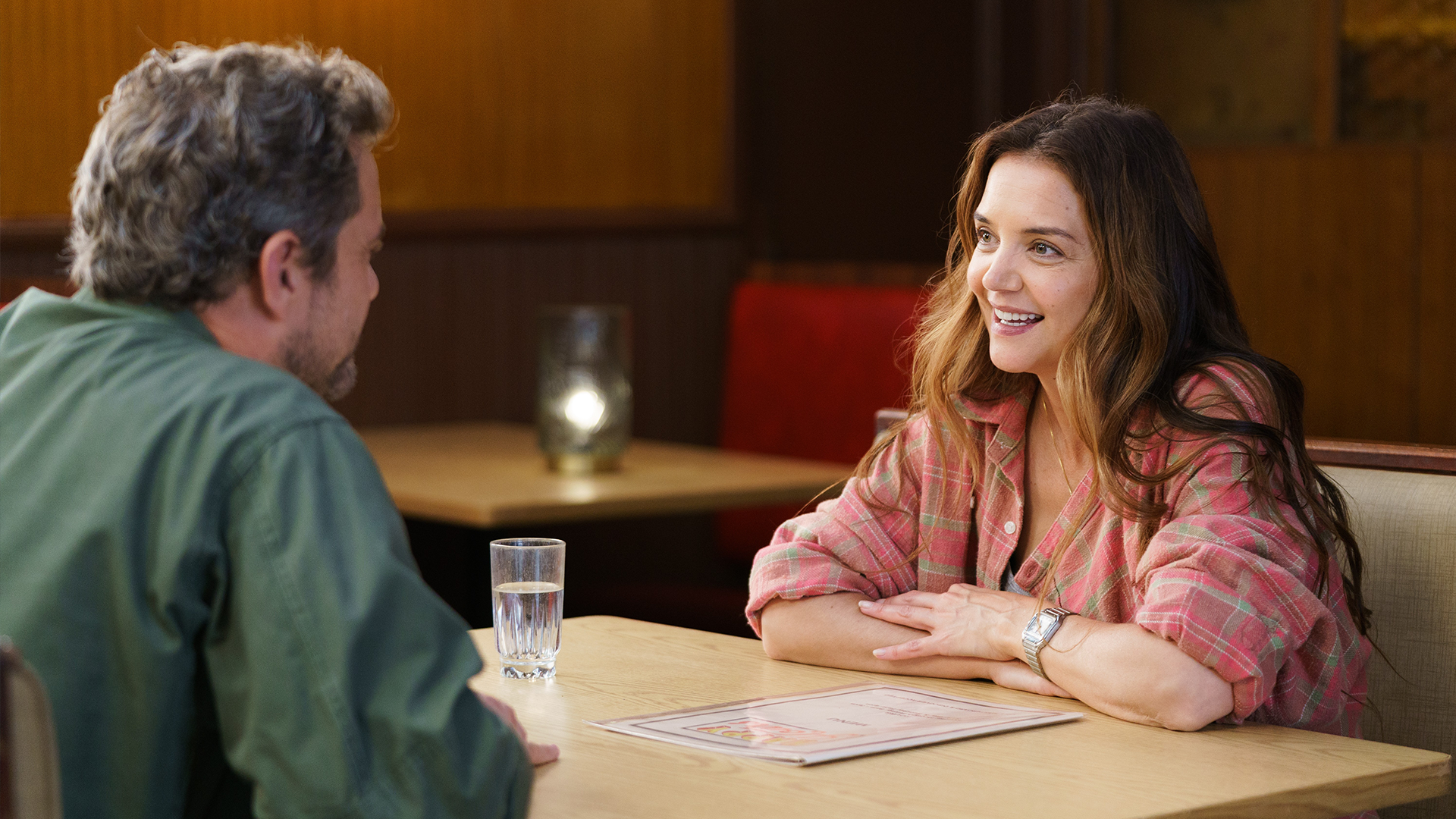
There is obvious built-in appeal to ‘Happy Hours,’ and Katie Holmes knows it. Reuniting with Joshua Jackson more than two decades after ‘Dawson’s Creek’ gives the film an immediate nostalgia hook, especially for viewers who still have affection for the emotional sincerity and soft-focus yearning of late-’90s teen television. Holmes, who writes, directs and stars, is clearly interested in what happens when old love is revisited later in life, after careers, marriages, disappointments and memory have all had time to reshape the people involved. That is a promising premise for a romantic drama, and for brief stretches, the presence of Holmes and Jackson together again gives the film a warmth it otherwise struggles to generate.
The trouble is that ‘Happy Hours’ never feels as emotionally spontaneous as the reunion it is selling. Holmes plays Liz, a recently divorced photojournalist trying to move away from celebrity work and toward more meaningful images of real people. Jackson plays Andrew, a successful travel writer with a new book and the kind of soulful, carefully arranged inner life that only exists in movies where everyone speaks as though they have been workshopping their self-awareness for years. When Liz accidentally spots Andrew in the background of one of her photographs, the coincidence leads to a professional assignment, an awkward reunion and eventually the familiar question of whether a relationship that ended long ago might still have unfinished business.
That setup could work beautifully if the film trusted ordinary behavior. Instead, Holmes fills the story with literary references, photogenic New York locations and conversations that too often announce their significance rather than discovering it. The city is filmed as an elegant romantic backdrop, with Central Park, Washington Square Park and Chinatown appearing less like places people live than locations selected to remind viewers they are watching a New York love story. There is pleasure in that kind of cinematic tourism, but ‘Happy Hours’ leans so heavily on atmosphere that the characters themselves can start to feel like accessories to the mood board.
Holmes and Jackson remain appealing screen presences, and their chemistry is real enough to make the film’s weaker choices more frustrating. Jackson has always been especially good at playing charm edged with melancholy, and he brings Andrew a relaxed openness that suggests a man who has spent years trying to turn emotional damage into wisdom. Holmes gives Liz a guarded softness, making her defensiveness understandable even when the script asks her to behave in ways that feel engineered rather than natural. Together, they have the kind of familiarity that cannot be faked, which is why it is so disappointing that the movie gives them so little believable material to play.
Much of the conflict depends on misunderstandings that would collapse if the characters spoke plainly for even a few seconds. That can be acceptable in a heightened romantic comedy, where artificial obstacles are part of the machinery, but ‘Happy Hours’ presents itself as something more mature and reflective. It wants to be about adulthood, regret, memory and the ache of wondering whether life closed a door too early. Yet it repeatedly falls back on contrivances that make its adults seem less emotionally evolved than the teenagers they once were.
The flashbacks to Liz and Andrew as young lovers are meant to deepen that sense of lost time, with Johnna Dias-Watson and Jack Martin playing their younger selves as earnest, Blondie-loving teenagers discovering both romance and heartbreak. Those scenes have a certain sweetness, but they also underline the film’s central problem: the past is treated more as an aesthetic than a fully developed emotional history. We understand that Liz and Andrew once mattered deeply to each other, but the reasons for their separation and decades of silence never carry the dramatic force the film needs them to have.
POPULAR ON THE CINEMA GROUP
The supporting cast does what it can with material that varies wildly in tone. Constance Wu appears as Liz’s agent, mostly functioning as a voice of professional impatience, while Mary-Louise Parker is asked to provide comic relief as Liz’s sexually liberated aunt. Parker is far too gifted an actor not to find a few amusing beats, but the character is written so broadly that her scenes feel imported from a different, much more forced movie. Joe Tippett and John McGinty fare better as Andrew’s friends, whose teasing dynamic and use of ASL give the film some of its more relaxed moments, though even those scenes occasionally seem designed to underline charm rather than let it emerge organically.
Holmes’ direction is sincere, and that sincerity matters. There is nothing cynical about ‘Happy Hours.’ It clearly believes in reconnection, emotional openness and the possibility that love can return in a different form after life has changed everyone involved. Holmes also has an eye for gentle visual texture, and she seems genuinely invested in giving her characters room to breathe. The film’s problem is not lack of feeling. It is that the feeling is too often arranged into poses, quotations and overly polished conversations instead of emerging from messy, specific human behavior.
That limitation becomes more pronounced because ‘Happy Hours’ is reportedly intended as the first installment of a trilogy. The comparison to Richard Linklater’s ‘Before’ films is difficult to avoid, but also unhelpful for Holmes’ movie. Linklater’s trilogy worked because the conversations felt simultaneously written and alive, with two characters revealing themselves in real time through interruption, contradiction, flirtation and conflict. ‘Happy Hours’ wants that same sense of accumulated romantic time, but its dialogue is too neat and its structure too convenient to capture the unpredictability of two people truly finding each other again.
Still, it is hard to completely dismiss a film this earnest. Holmes and Jackson are likable, soulful performers, and there are moments when their shared history creates emotional resonance the screenplay has not fully earned. For viewers primarily interested in seeing the former ‘Dawson’s Creek’ co-stars together again, that may be enough. Their reunion has novelty, affection and a degree of genuine warmth, even when the film surrounding them feels overly curated.
As a romantic drama, though, ‘Happy Hours’ never becomes convincing. It gestures toward longing without making the longing sting, invokes maturity while relying on immature misunderstandings, and surrounds its characters with beauty without giving their relationship enough truth. The film wants to feel like a bittersweet reflection on love revisited after decades apart. Too often, it plays like a fantasy of adulthood written in beautiful locations and underlined with literary references, but missing the unruly emotional texture that would make it real.
RATING: ★★☆☆☆
That’s a Wrap
|
Happy Hours
|
That’s a Wrap | Happy Hours |
“Katie Holmes and Joshua Jackson still have chemistry, but ‘Happy Hours’ turns a promising reunion into a stiff, over-curated romance that rarely feels believable.”
CREDITS
Release Date: Sat June 6, 2026 @ 5 PM [World Premiere]
Cast: Katie Holmes, Joshua Jackson, Constance Wu, Mary-Louise Parker, Joe Tippett, John McGinty, Johnna Dias-Watson, Jack Martin
Director-screenwriter: Katie Holmes
Festival: Tribeca Festival - [Spotlight Narrative]
Run Time: 1 Hour 20 Minutes
Rating: Not Yet Rated

| FEATURES | INTERVIEWS | REVIEWS | The Catalogue | TRENDING | TRAILERS | VIDEOS |





![WERWULF - Official Trailer [HD] - Only In Theaters Christmas](https://i.ytimg.com/vi/cmjpadVj-Vk/hqdefault.jpg)