‘Little Brother’ Review: John Cena and Eric André Get Stuck in Netflix’s Formulaic Raunch Comedy
(L to R) Pilot Bunch as Shane, Bryce Gheisar as Cory, John Cena as Rudd, Eric Andre as Marcus in Little Brother. Cr. Clifton Prescod/Netflix © 2026
John Cena and Eric André try to revive the R-rated odd-couple comedy, but Netflix’s ‘Little Brother’ feels too recycled, too obvious and too desperate to shock its way into genuine laughs.
There is nothing wrong with a recycled comedy formula if the laughs still land. The odd-couple roadblock, the uptight straight man, the chaotic man-child, the forced reunion, the domestic disruption, the inevitable emotional thaw — these are durable shapes for a reason. Comedy history is full of movies that work not because the premise is new, but because the performers find something alive inside it. ‘Little Brother,’ Netflix’s new R-rated comedy starring John Cena and Eric André, understands the formula perfectly. What it does not find is enough reason to run it again.
Directed by Matt Spicer and written by Jarrad Paul and Andrew Mogel, ‘Little Brother’ pairs Cena’s tightly wound real estate broker Rudd with André’s Marcus, the troubled former “little brother” Rudd briefly mentored back in high school. Years later, Rudd receives a call from a hospital and assumes the injured man must be his actual brother Josh, played by Christopher Meloni. Instead, the patient is Marcus, a barely remembered figure from Rudd’s past who has nowhere to go and no one else to call. Rudd wants to keep his distance, but his wife Dierdre, played by Michelle Monaghan, insists they bring Marcus home to recover.
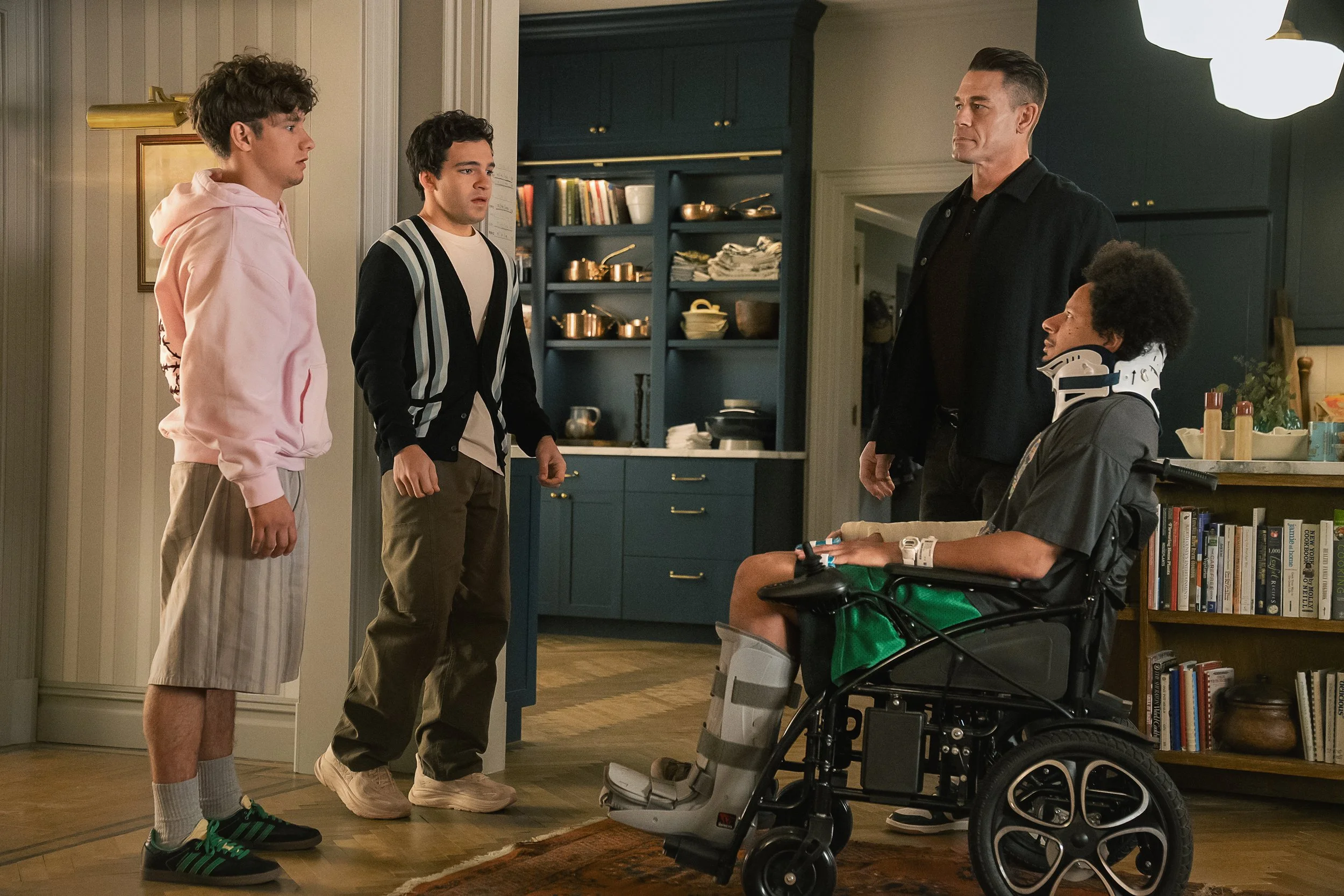
(L to R) Pilot Bunch as Shane, Bryce Gheisar as Cory, John Cena as Rudd, Eric Andre as Marcus in Little Brother. Cr. Clifton Prescod/Netflix © 2026
From there, the movie proceeds exactly as expected. Rudd is trying to prove himself professionally, land his moment on a reality series called ‘NYC Hustlers’ and escape the shadow of his richer, more successful brother. Marcus, meanwhile, is a walking disaster who turns every room, car, office and family situation into a gross-out incident waiting to happen. The idea is that Rudd’s controlled life needs to be wrecked before it can be repaired, and Marcus is the human wrecking ball sent to do the job.
That kind of setup can work, especially with two performers as physically and tonally different as Cena and André. Cena has become a genuinely useful comic actor because he understands how to weaponize his size. His best comedy performances play off the gap between his intimidating physical presence and the emotional confusion of the characters he plays. André, by contrast, is built for pure disruption. His comedy thrives on discomfort, volume and the sense that no social boundary is too sacred to be violated.

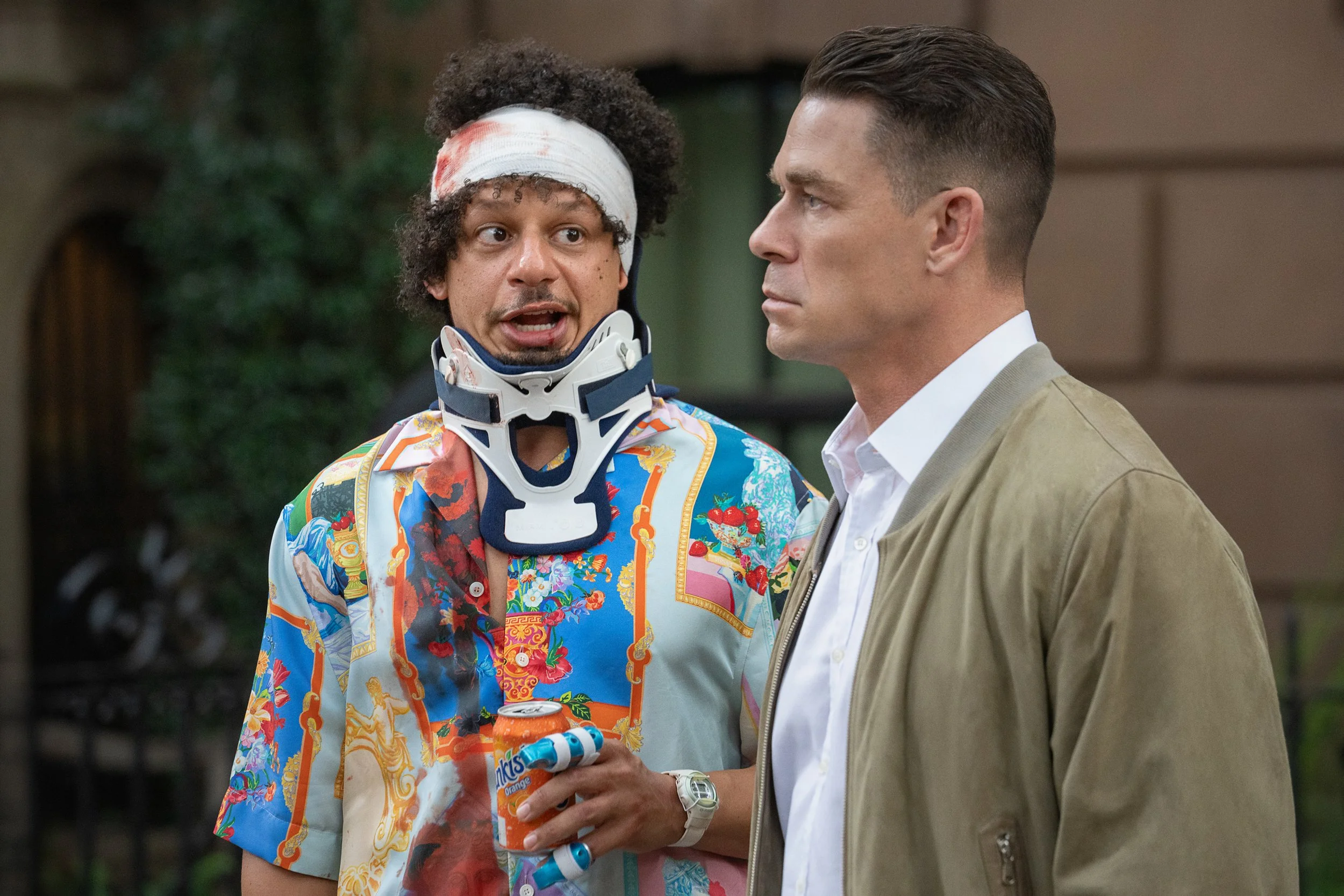
Eric Andre as Marcus in Little Brother. Cr. Clifton Prescod/Netflix © 2026
The problem is that ‘Little Brother’ rarely gives either actor a fresh angle to play. Cena spends much of the film locked into slow-burn frustration, while André does the kind of manic, self-sabotaging chaos audiences either already enjoy or already find exhausting. Their energy should clash in ways that escalate, but the film keeps steering them into obvious set pieces: bodily fluids, sexual humiliation, property damage, drugged-out catastrophe and family embarrassment. It is the kind of raunch comedy that mistakes extremity for invention.
The movie is clearly trying to revive the older studio-comedy tradition where embarrassment and body horror were part of the fun. There are echoes of ‘What About Bob?,’ ‘Planes, Trains and Automobiles,’ ‘Twins’ and the post-‘American Pie’ R-rated comedy wave, but ‘Little Brother’ does not absorb those influences so much as chew them up and spit them back in a blander streaming shape. It knows where the beats go. It knows when the uptight guy should snap, when the disaster friend should accidentally reveal wisdom and when the final act should soften the chaos into affection. But knowing the pattern is not the same as making it funny.
Some gags are designed purely to test the viewer’s tolerance. Marcus urinates where he should not. He has sex in places he should not. He offers graphic relationship advice to Dierdre involving anilingus as a cure for marital distance. A later sequence involving psychedelics and an emergency tracheotomy pushes the movie further into gross-out absurdity, but by then the film has already made its point several times over: Marcus is inappropriate, Rudd is mortified, and the audience is supposed to laugh because everyone has crossed a line.
There are moments when the performers nearly rescue it. Monaghan brings more warmth and patience than the script really earns, making Dierdre feel less like a stock supportive wife than she could have been. Meloni leans into his comic edge as Josh, and there is always pleasure in watching him take a sharp turn away from stern dramatic authority. Ego Nwodim and Caleb Hearon appear around the edges as production assistants, and both have enough timing to suggest a funnier movie might have existed if the supporting characters had been given more room to breathe.

(L to R) Eric Andre as Marcus, Michelle Monaghan as Deirdre in Little Brother. Cr. Clifton Prescod/Netflix © 2026
Spicer, who made the far sharper ‘Ingrid Goes West,’ gives the film a competent surface but never discovers a real comic rhythm beyond escalation. The movie keeps pushing for bigger humiliation, but it rarely builds jokes with precision. The best raunch comedies have architecture. They may look sloppy, but the chaos is actually controlled, each indignity topping the last until the absurdity becomes a kind of music. ‘Little Brother’ mostly feels assembled from familiar prompts, as if the algorithm asked for a John Cena/Eric André odd-couple vehicle with R-rated set pieces and a sentimental third act.
That algorithmic quality is hard to shake. Netflix has made a major public case for supporting prestigious filmmakers and serious cinema, but its comedy pipeline often feels built around recognizable stars and pre-sold formulas more than actual comic inspiration. ‘Little Brother’ is not lazy in the sense that no one is trying. Cena and André commit, the supporting cast shows up ready to play and the movie clearly wants to deliver the kind of big, crude, crowd-friendly laughs that have become rarer in theaters. But the final product feels strangely pre-digested, more like a memory of a raunch comedy than a living example of one.

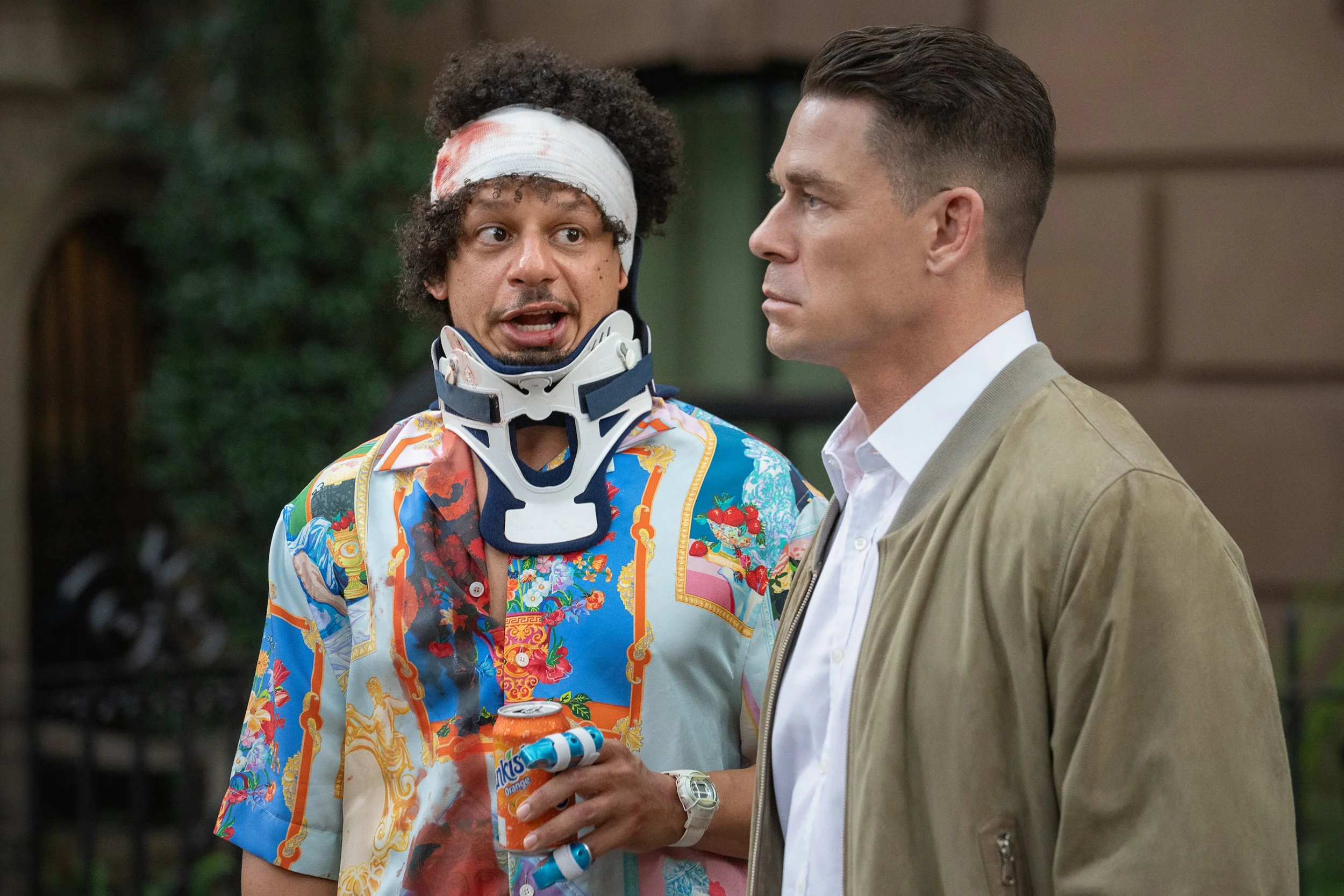
(L to R) John Cena as Rudd, Eric Andre as Marcus in Little Brother. Cr. Clifton Prescod/Netflix © 2026
The emotional turn is exactly where anyone would expect it to be. Rudd eventually learns that Marcus is not simply a nuisance, Marcus reveals more wounded need beneath the madness, and the movie nudges the pair toward an honorary sibling bond that is meant to make all the chaos feel worthwhile. But the sentiment does not land with much force because the relationship has been built more through incidents than character. We know Rudd needs to loosen up and Marcus needs to be loved. The movie never makes those realizations feel surprising.
POPULAR ON THE CINEMA GROUP
What is frustrating is that the premise contains a better, sharper movie. A man confronted by the abandoned person he once failed to mentor could have opened up real comic guilt. A washed-out former mentee invading the life of someone performing success for reality television could have said something funny about image, masculinity, charity and self-delusion. Cena and André could have been used to explore two different kinds of arrested development. Instead, ‘Little Brother’ keeps reaching for the nearest body-part joke.
That does not make it unwatchable. At 1 hour and 42 minutes, it moves quickly enough, and viewers who already enjoy André’s brand of anarchic discomfort may find more to like than those looking for a sturdier comedy. Cena remains game, even when the material lets him down, and there are scattered laughs from the sheer absurdity of individual moments. But scattered laughs are not enough to make a movie feel alive, especially when every turn can be spotted long before it arrives.
‘Little Brother’ wants to be rude, messy and heartfelt in the grand tradition of R-rated buddy comedies. Instead, it is mostly familiar, loud and strangely harmless. The raunch is there, the sentiment is there, the odd-couple structure is there, but the spark is missing. For a movie built around a character who detonates every social boundary in sight, it ends up feeling far too safe.
RATING: ★★☆☆☆
That’s a Wrap
|
Little Brother
|
That’s a Wrap | Little Brother |
“‘Little Brother’ has two committed comic leads in John Cena and Eric André, but Netflix’s odd-couple raunch comedy is too recycled and predictable to turn its gross-out chaos into lasting laughs.”
CREDITS
Release Date: Friday, June 26
Cast: John Cena, Eric André, Michelle Monaghan, Christopher Meloni, Ego Nwodim, Sherry Cola, Caleb Hearon, Ben Ahlers, Bryce Gheisar, Pilot Bunch
Director: Matt Spicer
Screenwriters: Jarrad Paul, Andrew Mogel
Streaming on: Netflix
Run Time: 1 hour 42 minutes
Rated R
Watch The Trailer Below:

| FEATURES | INTERVIEWS | REVIEWS | The Catalogue | TRENDING | TRAILERS | VIDEOS |





![WERWULF - Official Trailer [HD] - Only In Theaters Christmas](https://i.ytimg.com/vi/cmjpadVj-Vk/hqdefault.jpg)