‘The Revisionist’ Review: Dustin Hoffman Steals Every Scene in a Smart but Uneven Literary Drama
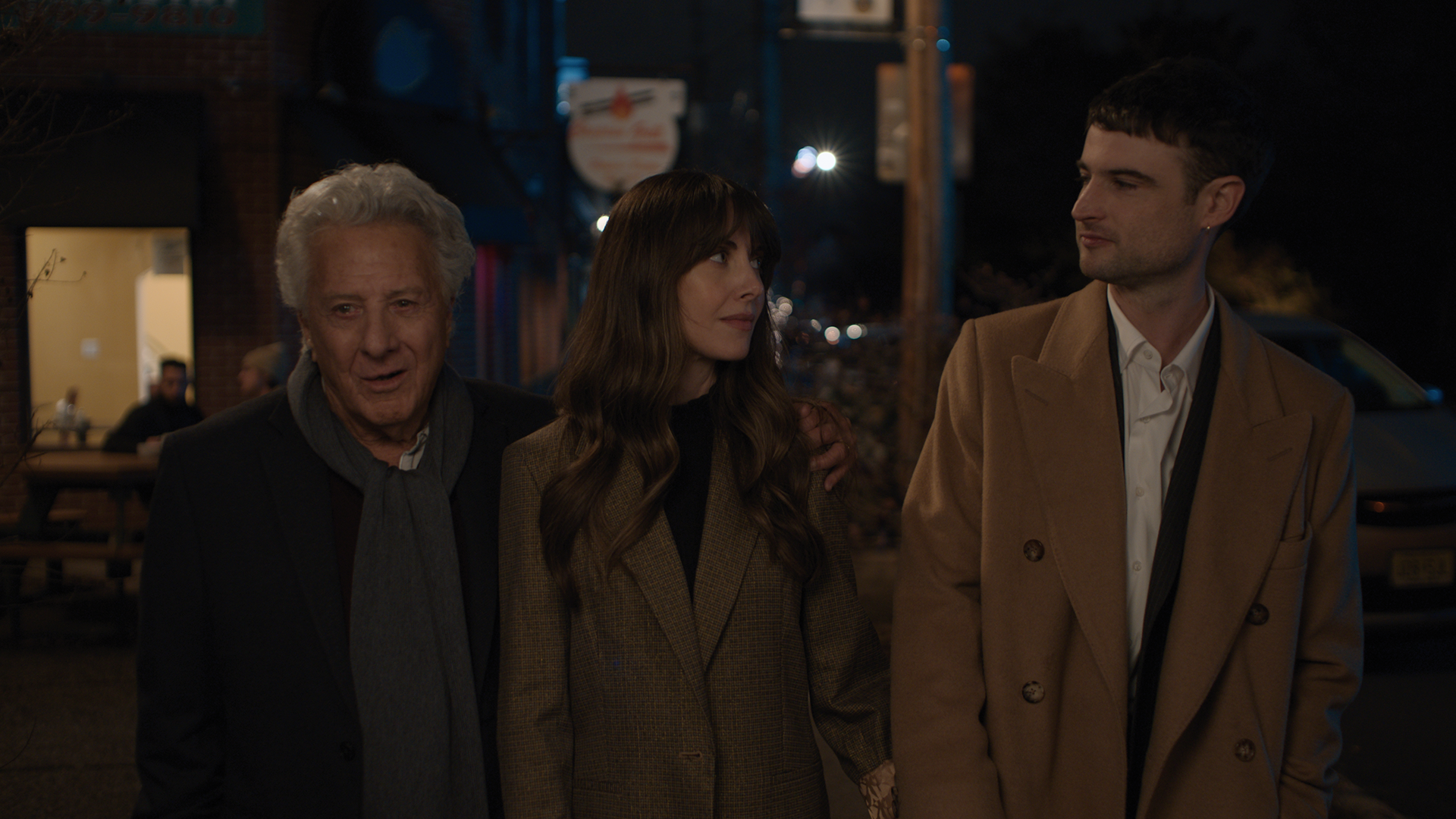
courtesy of Tribeca
Dustin Hoffman delivers a delightfully combustible performance as a celebrated author whose oversized personality threatens to consume everyone—and everything—around him.
There are actors who elevate a movie, and then there are actors who completely reshape it.
Dustin Hoffman does the latter in The Revisionist, a literary drama that spends much of its runtime debating who gets to tell a story, who owns the truth, and whether any biography can ever fully capture the complicated people at its center. Alex Vlack’s feature directorial debut arrives at Tribeca with a fascinating premise, a first-rate cast, and plenty of ideas about authorship and legacy. Yet for all of its intellectual ambitions, the film repeatedly finds itself pulled into the gravitational field of one performance.
Every time Hoffman appears, the movie wakes up.
He plays David, a celebrated American novelist whose reputation has transformed him into both a literary icon and a walking headache. Depending on who is speaking, David is either a national treasure or an impossible narcissist. Both descriptions seem equally accurate. He’s witty, manipulative, charming, dismissive, insightful, selfish, and endlessly entertaining, often within the same conversation.
The problem for everyone around him is that David knows exactly how magnetic he is.
That includes his son Jacob (Tom Sturridge), an advertising copywriter attempting to write his father’s biography. Jacob hopes the project will finally help him understand the man who has spent most of his life keeping him at arm’s length. He also hopes it might establish his own literary credibility. Unfortunately, David has absolutely no interest in cooperating.
This creates the central tension that drives much of the film. Desperate for access, Jacob and his wife Elise (Alison Brie) devise a plan involving their old friend John (André Holland), a gifted writer whom David genuinely admires. Since David seems willing to open up around John, perhaps he can quietly gather stories and insights that Jacob can use for the biography.
Predictably, things become complicated almost immediately.
What begins as a story about literary legacy gradually transforms into something larger about ambition, envy, authenticity, and the stories people tell themselves. Nearly every character is attempting to author a version of reality that benefits them. Jacob wants validation. John wants relevance. Elise wants creative fulfillment. David wants control.
Nobody is entirely honest. That’s where The Revisionist becomes most interesting.
The strongest stretches of the film function almost like a comedy of manners set within literary circles. David’s casual cruelty, John’s effortless charisma, Jacob’s growing insecurity, and Elise’s frustration create an entertaining web of competing agendas. The screenplay frequently circles questions about authorship and ownership without offering easy answers. Who has the right to tell someone’s story? Is truth more important than perspective? Can any creative work ever be truly objective?
Those ideas provide fertile ground for satire, particularly in an era obsessed with memoirs, biographies, documentaries, and public confessions.
Unfortunately, the film never fully commits to its sharpest instincts.
Vlack occasionally seems torn between creating a literary character study, a relationship drama, and a metafictional examination of storytelling itself. Each individual element works well enough on its own, but the transitions between them can feel uneven. Storylines emerge that appear poised to deepen the film’s themes before drifting elsewhere. Narrative turns that should feel revelatory occasionally arrive with less impact than intended because the film has already signaled where things are heading.
Even so, there is plenty to admire.
Sturridge brings a quiet desperation to Jacob that keeps the character sympathetic even when his insecurities become frustrating. He understands that Jacob isn’t merely seeking professional success. He’s searching for approval from a father who may never be capable of giving it.
André Holland continues his remarkable streak of elevating every project he enters. John could easily have become a simplistic rival figure, but Holland gives him enough warmth, confidence, and ambiguity to keep viewers guessing about his motivations. His scenes with Hoffman are among the film’s strongest because both actors understand how power operates within conversation. Watching them verbally circle one another becomes its own form of
entertainment.
Alison Brie faces the most difficult assignment.
The screenplay clearly wants Elise to function as an emotional and intellectual center, yet it never quite figures out how to make her as compelling as the men surrounding her. Brie does admirable work with the material she’s given, finding layers of frustration and longing beneath Elise’s composed exterior. Still, there’s a lingering sense that the film continually sidelines one of its potentially most interesting characters.
That’s particularly frustrating because many of the film’s biggest themes naturally intersect with her perspective.
Elise is surrounded by men obsessed with legacy, recognition, and authorship. Each believes his creative voice deserves attention. Each is convinced his story matters. Yet the film often seems more interested in observing that dynamic than fully allowing Elise to challenge it.
The result is a character who feels partially underserved despite occupying a significant amount of screen time.
Fortunately, Hoffman remains an irresistible force throughout.
At eighty-eight, the Oscar winner appears to be having tremendous fun inhabiting David. He chews scenery with the confidence of someone who has absolutely nothing left to prove. David drinks too much, says exactly what he’s thinking, ignores social conventions, and bulldozes every room he enters. In lesser hands, the character could become exhausting. Hoffman somehow makes him exhilarating.
What makes the performance work is that he never asks viewers to forgive David’s flaws. Instead, he embraces them. David’s selfishness, arrogance, and cruelty are inseparable from the qualities that make him fascinating. Hoffman understands that charismatic people are often difficult people, and he refuses to sand down any of the character’s sharper edges.
The film’s best scenes simply allow him to talk.
Whether he’s recounting old stories, dismissing literary pretension, or humiliating someone without realizing it, Hoffman creates the sense of a man whose entire life has become performance. Even when David is being terrible, you understand why people continue gravitating toward him.
That’s both the character’s greatest strength and the film’s.
By the time The Revisionist reaches its conclusion, some of its larger thematic ambitions remain frustratingly unresolved. Certain narrative choices feel more clever than insightful, and some ideas prove more compelling in theory than execution. Yet the film remains engaging because it understands the appeal of complicated personalities and the messy relationships they leave behind.
Ultimately, The Revisionist may not fully deliver on every one of its ambitions, but it succeeds as a showcase for a legendary performer who reminds audiences exactly why he’s a legend in the first place.
When Dustin Hoffman is on screen, everyone else—including the movie itself—is simply trying to keep up.
Rating: ★★★½☆
That's A Wrap
|
The Revisionist
|
That's A Wrap | The Revisionist |
“Dustin Hoffman pours himself a morning Negroni and casually walks away with the entire movie ”
CREDITS
Release Date: June 5, 2026 @ 5PM [Tribeca OKX Theater at BMCC TPAC]
Cast: Dustin Hoffman, Tom Sturridge, Alison Brie, André Holland
Director: Alex Vlack
Screenwriter: Alex Vlack
Festival: Tribeca Festival 2026
Run Time: 90min

| FEATURES | INTERVIEWS | REVIEWS | The Catalogue | TRENDING | TRAILERS | VIDEOS |







![WERWULF - Official Trailer [HD] - Only In Theaters Christmas](https://i.ytimg.com/vi/cmjpadVj-Vk/hqdefault.jpg)