‘The Gallerist’ Review: Natalie Portman and Jenna Ortega Take a Big Swing in a Miami Art-World Satire
COURTESY OF SUNDANCE
Cathy Yan’s Sundance satire has a killer premise and a stacked cast — and even when the film doesn’t land every punch, it’s stylish, watchable, and more fun than its messy reputation suggests.
There are certain modern industries that feel like they were engineered in a lab for cinema: loud, competitive, visually rich, filled with power games and social performance, and fueled by the kind of desperation that only shows up when money and identity get tangled together. The contemporary art world is absolutely one of them. It’s an ecosystem where the line between genius and grift is intentionally blurry, where taste is treated like a birthright, and where the most ridiculous headline is often still less absurd than what’s happening in the room next door.
So on paper, ‘The Gallerist’ feels like an easy win. A Sundance-ready satire set during Art Basel, built around a premise that sounds like it came from a perfectly cynical late-night brainstorm: a Miami gallery owner accidentally ends up with a dead body on her hands — and, instead of calling the police, she turns it into conceptual art.
That’s not just a hook. That’s an entire movie engine.
Writer-director Cathy Yan, coming off the kinetic pop chaos of ‘Birds of Prey,’ approaches ‘The Gallerist’ with the kind of restless momentum you want from this story. She shoots the gallery like it’s a battlefield disguised as a showroom. The camera moves like it’s eavesdropping, circling, catching faces mid-calculation, turning a sleek white space into something claustrophobic and predatory. And for the first stretch, the film is doing exactly what you want it to do: it’s fast, it’s tense, it’s funny in that specific way where people are being polite while their souls are actively leaving their bodies.
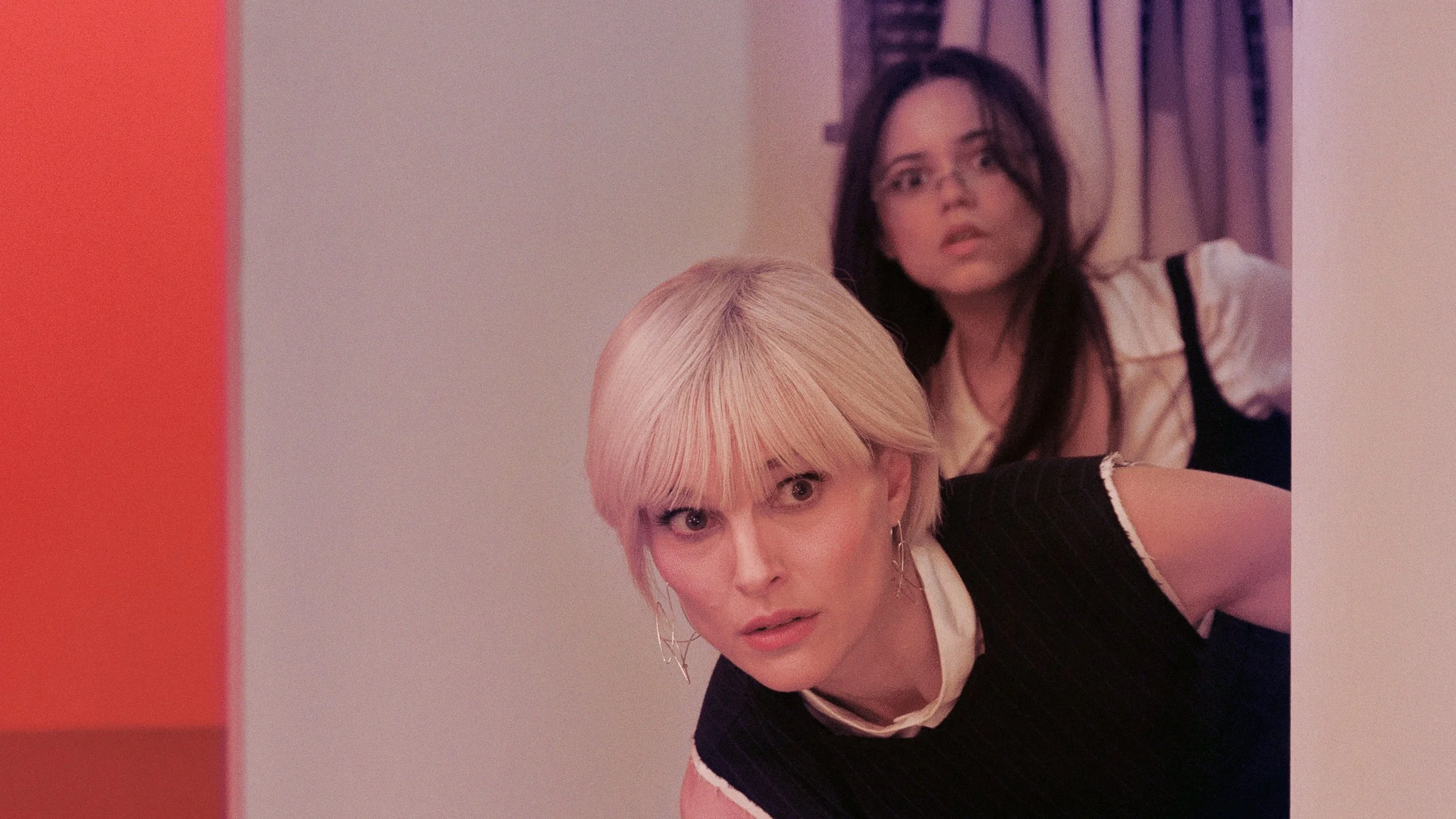
Natalie Portman plays Paulina Polinski, a gallery owner with a curated exterior and a nervous system that’s permanently set to “fight or flight.” Paulina isn’t just trying to have a successful week at Art Basel — she’s trying to prove she belongs there at all. She’s trying to maintain the illusion of control while everything around her screams that she’s one mistake away from becoming irrelevant. Yan and Portman give her the kind of anxious precision that reads instantly: the too-bright smile, the overly measured voice, the way she’s always scanning the room for who matters, who doesn’t, and who might destroy her with one sentence.
Paulina’s desperation is the movie’s real fuel. She’s the kind of person who can convince herself that any decision is justified if it keeps the doors open. And in the art world, where branding is everything and moral clarity is optional, that desperation isn’t even unusual — it’s practically expected.
The inciting incident arrives with delicious speed. An influencer — the film’s embodiment of modern cultural parasites — shows up like a walking disruption. He’s loud, entitled, and smugly convinced that his presence is a gift to the room. The encounter escalates into an accident, and suddenly the movie delivers its thesis in one brutal visual: a dead man, a sculpture, and a gallery owner realizing that the worst thing that could happen might also be the best thing that could happen.
Because in this world, tragedy is not only survivable — it’s marketable.
That’s where ‘The Gallerist’ is at its sharpest. It understands the sick logic of cultural capitalism: everything is content, everything is a story, everything is a “moment.” Even death can be framed, titled, lit properly, and sold. It’s a perfect satire target because it’s not even that exaggerated. We’ve all watched public disasters turn into merch drops and brand campaigns in real time. The film just pushes the logic one step further, into something grotesque and almost elegant.
Paulina’s choice to reposition the body and reframe the sculpture as a new piece of conceptual work is the kind of decision that only makes sense inside a movie — but it also makes perfect sense inside this specific ecosystem. It’s not just that she’s trying to cover her tracks. She’s trying to win. She’s trying to survive. She’s trying to keep the gallery from collapsing. And maybe, in the darkest part of her mind, she’s trying to prove she can outsmart everyone in the room.
Jenna Ortega plays Kiki, Paulina’s assistant, and she’s arguably the film’s most effective anchor. Kiki is the kind of assistant who isn’t just doing tasks — she’s doing damage control. She’s watching the world burn and calmly asking where the fire extinguisher is. Ortega gives her a sharp, contained energy that works perfectly against Portman’s spiraling intensity. Kiki is younger, more plugged into the current culture, and still capable of being shocked — but she’s also practical enough to know that shock doesn’t help. Ortega plays her like someone who has already accepted that every job is some version of compromise.
Da’Vine Joy Randolph is another key piece of the puzzle, playing the artist Paulina is betting her future on. Randolph brings a grounded warmth that cuts through the film’s icy satire, and it’s one of the smartest choices ‘The Gallerist’ makes: the artist is not the punchline. She’s not a caricature. She’s a human being trying to create something real in a world that mostly rewards spectacle.
And that dynamic — between the art itself and the industry surrounding it — is where the film has real potential. It flirts with deeper questions about who gets elevated, who gets exploited, and who gets to decide what “important” art even is. It also hints at the ways a rising Black artist can be treated as both talent and commodity in a space that is overwhelmingly controlled by gatekeepers who claim to be progressive while behaving like predators.
The film doesn’t fully develop those ideas into something as pointed as it could be, but the fact that it’s even circling them gives it more weight than a simple “art people are ridiculous” comedy.
Then there’s Catherine Zeta-Jones, who shows up like a luxury weapon. She plays a hard-charging art dealer with the kind of effortless dominance that only comes from someone who has never had to ask permission for anything in her life. Zeta-Jones understands exactly what movie she’s in, and she brings a sleek, amused cruelty that makes every scene sharper. Her presence alone elevates the satire because she’s not playing the world as absurd — she’s playing it as normal. And that’s the scariest part.
As the chaos builds, Yan keeps the film moving with the right kind of frantic rhythm. People whisper, panic, pivot. Conversations become negotiations. Every interaction feels like a transaction. The gallery becomes a pressure cooker of public performance and private breakdowns. And for a while, ‘The Gallerist’ feels like it’s on track to become one of those Sundance crowd-pleasers: stylish, nasty, funny, and just smart enough to make you feel complicit for laughing.
Where the film starts to wobble is in its second half, when the plot begins to expand outward and the movie seems less certain about what it wants to be. Is it a tight, escalating farce about the commodification of everything? Is it a character study of a woman collapsing under the weight of her own ambition? Is it a caper? A thriller? A social satire? A moral fable?
Yan seems to want a bit of everything, and the film’s energy sometimes gets spread thin as a result. The jokes don’t disappear — there are still plenty of moments that hit — but the momentum starts to feel more mechanical, like the movie is trying to keep the premise alive rather than letting it naturally evolve into something sharper.
Portman, for her part, commits hard. She’s playing Paulina with big choices: the brittle confidence, the desperation, the frantic self-mythologizing. And while that intensity works beautifully in the first half, there are moments later on where the performance feels like it’s searching for the film’s missing clarity. It’s not that Portman is bad — she’s not. It’s that the movie doesn’t always give her a clean runway to land the emotional beats it’s aiming for.
Ortega remains steady, Randolph remains grounded, and Zeta-Jones remains a menace in the best way. The cast is doing real work here. The film never feels lazy. It feels like a movie made by people who know the tone they want — even if they don’t always hit it with perfect precision.
And yet, for all its unevenness, ‘The Gallerist’ remains watchable, entertaining, and often genuinely funny. The art-world setting is visually satisfying in a way that’s hard to resist — the clean lines, the sterile luxury, the constant feeling that you’re watching a high-end performance piece where the real art is the manipulation. Yan knows how to shoot this world so that it looks seductive and repulsive at the same time. The gallery is beautiful, but it feels haunted. The wealth is dazzling, but it feels poisonous.
POPULAR ON THE CINEMA GROUP
What ‘The Gallerist’ ultimately gets right — even when it stumbles — is the feeling of a world where meaning is constantly being manufactured in real time. Where people speak in buzzwords, sell emotions, and treat morality like a flexible accessory. It’s a satire that doesn’t always cut as deep as it could, but it still understands the fundamental joke: that the modern art world is less about art than it is about power, narrative control, and the ability to convince someone that your lie is worth more than their truth.
If you go into ‘The Gallerist’ expecting a perfect scalpel, you might be disappointed. It’s not a flawless takedown. It doesn’t always sharpen its critique into something unforgettable. But if you go into it wanting a stylish, frantic, darkly funny Sundance swing — with Portman and Ortega anchoring the chaos and Yan bringing real visual energy — it delivers more than enough to justify the ride.
And honestly, in a festival lineup full of films trying to be the definitive statement on something, there’s something refreshing about a movie that’s willing to be messy, bold, and entertaining — even if it doesn’t land every punch cleanly.
Rating: ★★★☆☆
That's A Wrap
|
The Gallerist
|
That's A Wrap | The Gallerist |
“A killer premise, a stacked cast, and enough stylish chaos to keep it moving — ‘The Gallerist’ doesn’t land every punch, but it’s a bold, entertaining Art Basel satire that’s far more fun than it is fussy.”
CREDITS
Airdate: Sunday, January 25, 2026 | Sundance Film Festival
Cast: Natalie Portman, Jenna Ortega, Da’Vine Joy Randolph, Catherine Zeta-Jones
Creators: Cathy Yan (Director/Writer), James Pedersen (Writer)
Out Now: Premiered at Sundance Film Festival (distribution TBA)
Rating: Not Rated





![WERWULF - Official Trailer [HD] - Only In Theaters Christmas](https://i.ytimg.com/vi/cmjpadVj-Vk/hqdefault.jpg)