‘Goodbye June’ Review: Kate Winslet’s Directorial Debut Finds Grace, Even When the Tears Come Too Easily
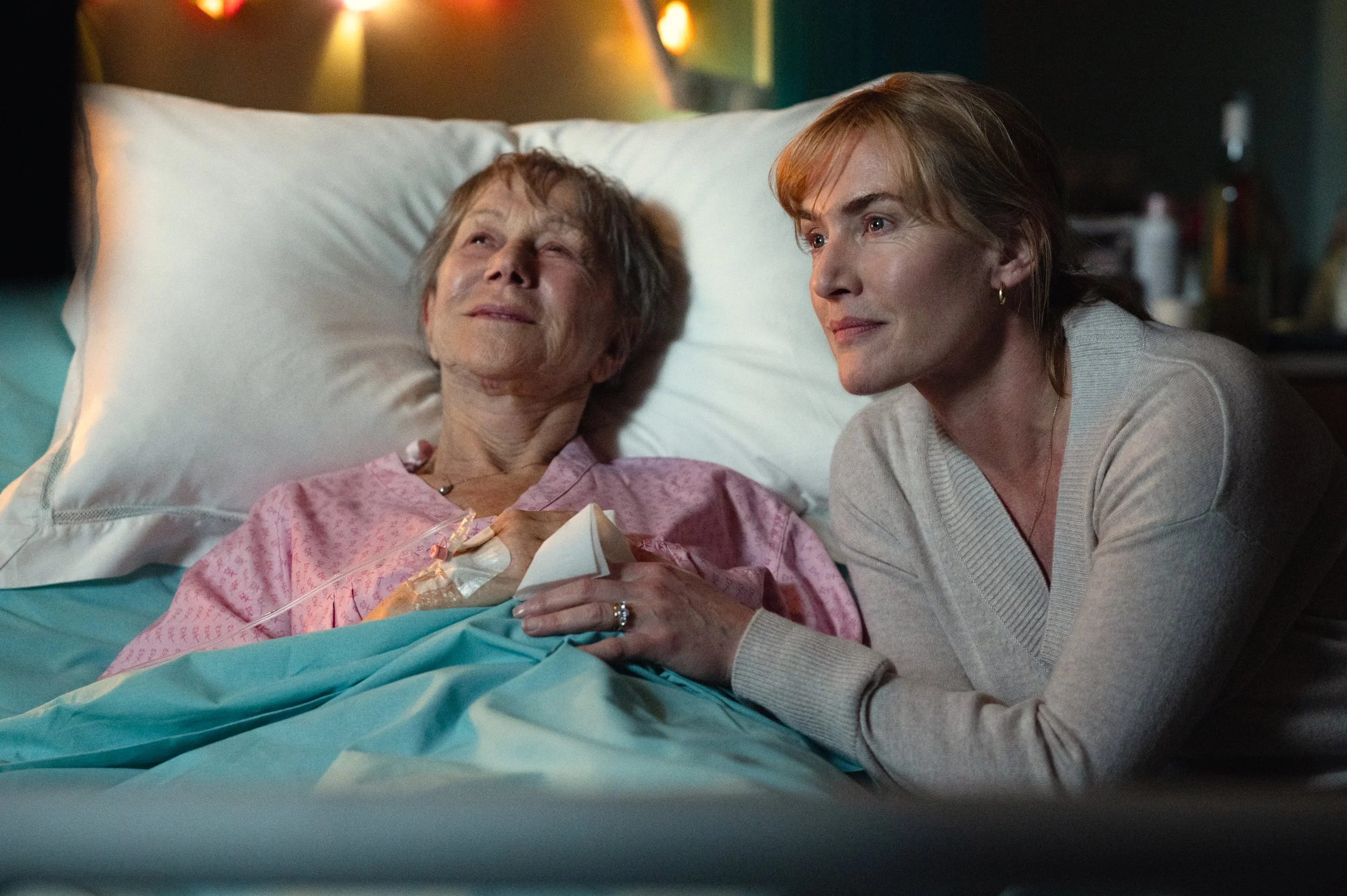
(L to R) Helen Mirren as June, Kate Winslet as Julia in Goodbye June. Cr. Kimberley French/Netflix
Kate Winslet’s directorial debut leans heavily into sentiment, but a magnificent ensemble — led by Helen Mirren — gives this intimate Netflix drama its emotional weight and credibility.
Kate Winslet has always been drawn to emotional truth. As an actor, her greatest strength has never been transformation or theatrical bravura, but authenticity — a grounded presence that makes even heightened emotion feel lived-in rather than performed. That instinct carries directly into her first feature as a director. Goodbye June is a deeply felt, sometimes over-insistent family drama about grief, inheritance, and unresolved love, redeemed — and frequently elevated — by one of the strongest ensembles Netflix has assembled in years.
This is a film preoccupied with endings: the end of a life, the end of a family’s shared center, the end of the emotional shortcuts that allow people to avoid saying what matters until it’s almost too late. Winslet approaches these themes without irony or distance. There is no tonal hedge here, no attempt to subvert the genre. Goodbye June is, unapologetically, a film about dying — and about the emotional debris left behind when death forces people to finally look at one another clearly.
At the center of the story is June, played with devastating restraint by Helen Mirren, a family matriarch hospitalized with terminal cancer as her sprawling family gathers for what may be their final goodbye. Set two weeks before Christmas, the film makes no attempt to disguise its intentions. This is a story engineered to make you cry, and it pursues that goal with unapologetic directness. At times, the emotional pressure tips into excess. Yet even when the screenplay leans too hard on sentiment, Winslet’s direction — and the cast’s extraordinary commitment — prevents the film from collapsing into melodrama.
June herself is not a sainted figure. She is loving but withholding, present yet emotionally guarded, a woman whose strength has come at the cost of emotional accessibility. Mirren understands this instinctively. She plays June not as a symbol of maternal wisdom, but as a woman who has made compromises, who has loved imperfectly, and who now faces the reckoning of what she will and won’t leave behind. Her performance is stripped of vanity: stooped posture, thinning hair, a face allowed to register exhaustion without cosmetic protection. Mirren knows when to recede, when silence carries more weight than dialogue.
One late-night scene captures the film’s quiet power. June lies alone in her hospital bed, eyes open in the dark, the family gone. She begins to cry — softly, without spectacle. It’s a moment many films would underline with music or dialogue. Winslet lets it breathe. Mirren makes it unforgettable.
The screenplay, written by Winslet’s son Joe Anders, is intimate to the point of familiarity. These characters feel real — perhaps because they resemble people we all recognize — but the structure relies heavily on recognizable beats. Buried resentments surface. Long-silent grievances are aired. Misunderstandings are clarified just in time. You can often sense where scenes are heading before they arrive. And yet, the film’s emotional effectiveness lies not in surprise, but in execution.
Winslet herself plays Julia, June’s polished, high-achieving daughter, a woman juggling a demanding career, three children, and the slow realization that professional success has not insulated her from loss. Julia is efficient, controlled, and deeply uncomfortable with emotional exposure — a woman who has learned to manage life through competence rather than vulnerability. Winslet plays her with restraint, allowing cracks to appear gradually rather than erupting in catharsis.

(L to R) Andrea Riseborough as Molly, Kate Winslet as Julia in Goodbye June. Cr. Kimberley French/Netflix
Opposite her is Andrea Riseborough’s Molly, a younger sister overwhelmed by domestic responsibility and financial strain, her resentment simmering just beneath the surface. Where Julia controls, Molly explodes. Riseborough gives one of the film’s most ferocious performances, allowing Molly’s anger to spill out in ways that feel ugly, impulsive, and painfully honest. She is not positioned as morally superior — just emotionally exhausted. Their scenes together are the film’s most electric, bristling with years of unspoken comparison and disappointment. These conversations feel accumulated, not engineered. They are the kinds of arguments that only siblings can have — fueled by intimacy rather than cruelty.

(L to R) Johnny Flynn as Connor, Helen Mirren as June in Goodbye June. Cr. Kimberley French/Netflix
Johnny Flynn delivers one of the film’s quietest yet most affecting performances as Connor, the adult son who never quite left home. Flynn gives Connor a fragile, unfinished quality — a man whose identity has long been tethered to his parents and who now faces the terrifying prospect of defining himself alone. His performance avoids caricature. Connor is not infantilized; he is stalled. The film allows him the dignity of gradual growth, culminating not in a grand revelation, but in the reluctant acceptance of responsibility.
Not every character lands as cleanly. Toni Collette’s Helen, introduced mid-holistic dance class and armed with sage, feels overdesigned — a familiar “free spirit” archetype deployed to widen the family dynamic. Collette commits fully, as she always does, but the character feels imposed rather than organic. Timothy Spall’s father figure, emotionally distant and beer-in-hand, is given a late pivot that feels abrupt and underdeveloped. These choices don’t derail the film, but they do expose the screenplay’s reliance on narrative convenience rather than discovery.

Kate Winslet and Tonii Colette in Goodbye June - Photo Credit: Kimberley French / Netflix
What ultimately steadies Goodbye June is its attention to the margins — the people who orbit grief without being at its center. Chief among them is Fisayo Akinade’s Nurse Angel, a presence of extraordinary warmth and quiet authority. Angel is not written as a miracle worker or a sentimental guide. Instead, he represents a different relationship to death — one shaped by proximity rather than fear.
Akinade plays Angel with gentle humor and unforced compassion, grounding the film whenever it risks tipping into emotional excess. His line to Connor — “I make it my duty to make sure people get good goodbyes” — could easily feel scripted or symbolic. Instead, Akinade delivers it as lived truth. Angel understands something the family struggles to accept: that death does not have to be chaotic to be devastating, and that dignity is not the same as denial.

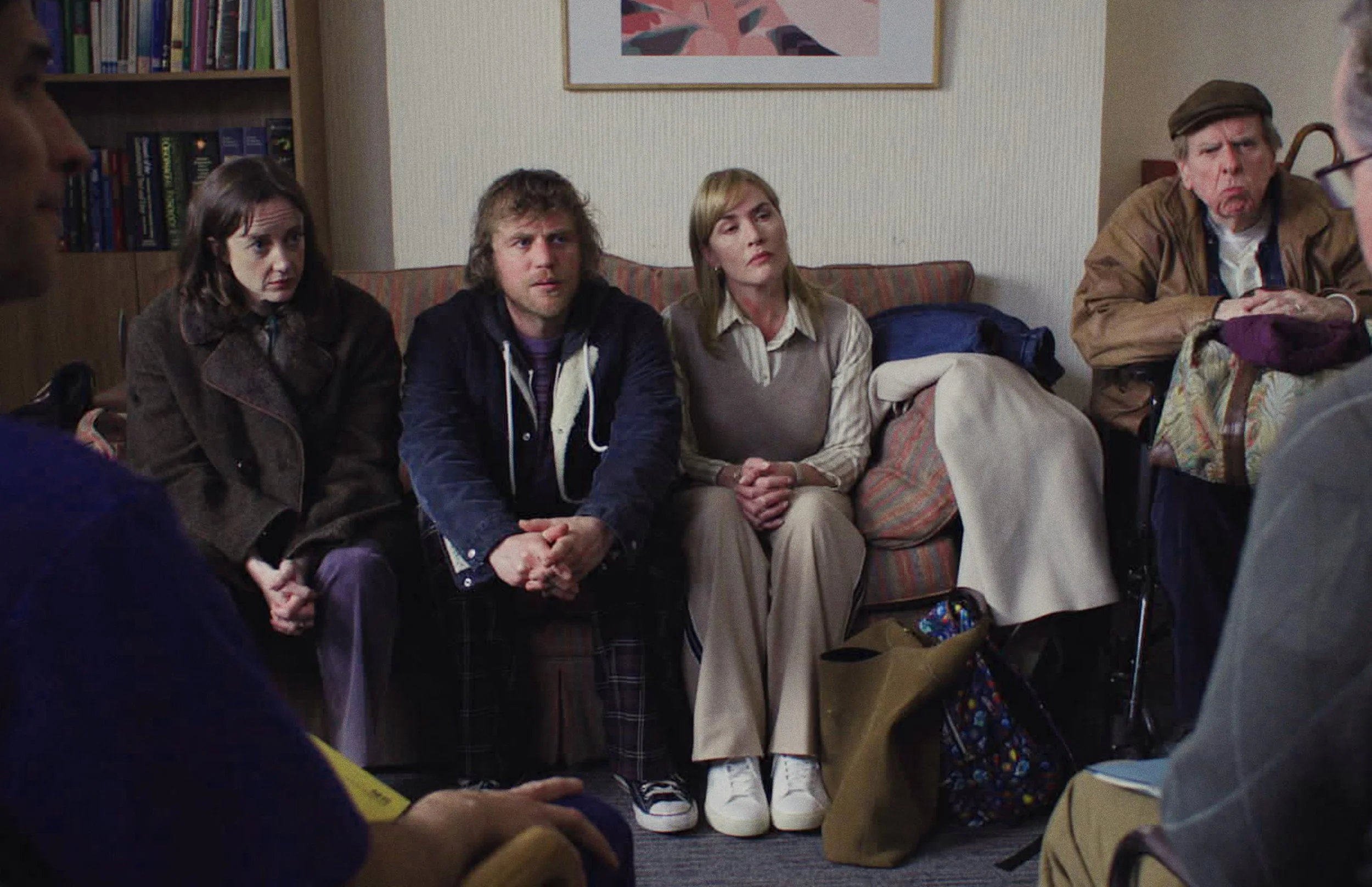
(L to R) Johnny Flynn as Connor, Andrea Riseborough as Molly, Timothy Spall as Bernie, Kate Winslet as Julia, Fisayo Akinade as Nurse Angel in Goodbye June. Cr. Kimberley French/Netflix
In many ways, Angel functions as the film’s moral anchor. He is present without intruding, supportive without instructing. In a story crowded with unresolved history, he offers a vision of care unburdened by legacy. His scenes subtly reframe the film’s central conflict — reminding us that grief is not only about what we lose, but about how we choose to witness that loss.
As a director, Winslet shows surprising confidence. Her visual approach is restrained and fluid, favoring close-ups and patient camera movement over stylistic flourish. Most of the film unfolds within June’s hospital room — a potentially claustrophobic setting — yet Winslet avoids stagnation through careful blocking and emotional modulation. Characters enter and exit with intention. Conversations overlap. Silence is allowed to linger.
The film’s more overtly sentimental gestures — a Christmas tree wheeled into the hospital room, grandchildren staging a Nativity performance — are undeniably manipulative. But Winslet stages them without mockery or embarrassment. She understands that grief often clings to ritual, however contrived it may appear from the outside. These moments are not about realism so much as emotional survival.
The emotional manipulation of Goodbye June is undeniable. The film wants your tears, and it knows how to earn them. What separates it from lesser tearjerkers is its refusal to condescend to grief. Winslet understands that loss is rarely neat, rarely linear, and often deeply uncomfortable. When the film works best, it does not instruct you how to feel — it simply places you in the room and lets the actors do the rest.
POPULAR ON THE CINEMA GROUP
Despite its predictability, Goodbye June emerges as a confident, emotionally resonant debut. It establishes Winslet as a director with a sharp instinct for performance, emotional rhythm, and human behavior. It also suggests that Joe Anders possesses genuine talent, even if his future work would benefit from greater structural risk and narrative daring.
This is not a perfect film. It is, however, a deeply human one — intimate, flawed, and carried by artists operating at the height of their craft. In a streaming landscape crowded with algorithmic sentimentality, Goodbye June stands out not for reinventing the genre, but for honoring it with sincerity.
And sometimes, that is more than enough.
RATING: ★★★★
That's A Wrap
|
Goodbye June [2025]
|
That's A Wrap | Goodbye June [2025] |
“Kate Winslet’s directorial debut leans hard into emotion, but it earns it — a beautifully acted, deeply humane family drama elevated by one of the year’s most formidable ensembles.”
CREDITS
Release Date: Friday, December 12, 2025
Streaming: December 24th, 2025 on Netflix
Director: Kate Winslet
Writer: Joe Anders
Cast: Helen Mirren, Kate Winslet, Andrea Riseborough, Johnny Flynn, Toni Collette, Timothy Spall, Stephen Merchant, Fisayo Akinade
Runtime: 1 hour 54 minutes
Rating: R
Out Now: In Theaters
Watch The Trailer Below:










![WERWULF - Official Trailer [HD] - Only In Theaters Christmas](https://i.ytimg.com/vi/cmjpadVj-Vk/hqdefault.jpg)