‘Dog Day Afternoon’ Broadway Review: Jon Bernthal Surprises in a Bold, Crowd-Pleasing Reinvention

Jon Bernthal in 'Dog Day Afternoon.' MATTHEW MURPHY AND EVAN ZIMMERMAN
Jon Bernthal sheds every tough-guy expectation in a performance that finally lets him surprise you.
There’s a version of this conversation that suggests adapting ‘Dog Day Afternoon’ for the stage is inherently misguided, that Al Pacino’s performance is too iconic to revisit, and that any attempt to translate the film into a theatrical experience is destined to fall short of its legacy. That perspective has shaped much of the early reaction to this production, but it doesn’t fully account for what’s actually happening on stage.
What becomes clear almost immediately is that this adaptation is not trying to escape the film’s shadow, nor is it attempting to redefine the material in a way that ignores its origins. Instead, it acknowledges the weight of that legacy and works within it, using familiarity as a foundation rather than an obstacle. Jon Bernthal’s performance operates directly inside that framework, drawing from Pacino’s cadence and volatility without feeling trapped by imitation. The influence is unmistakable, but it’s handled with a level of awareness that allows the performance to feel intentional rather than derivative.
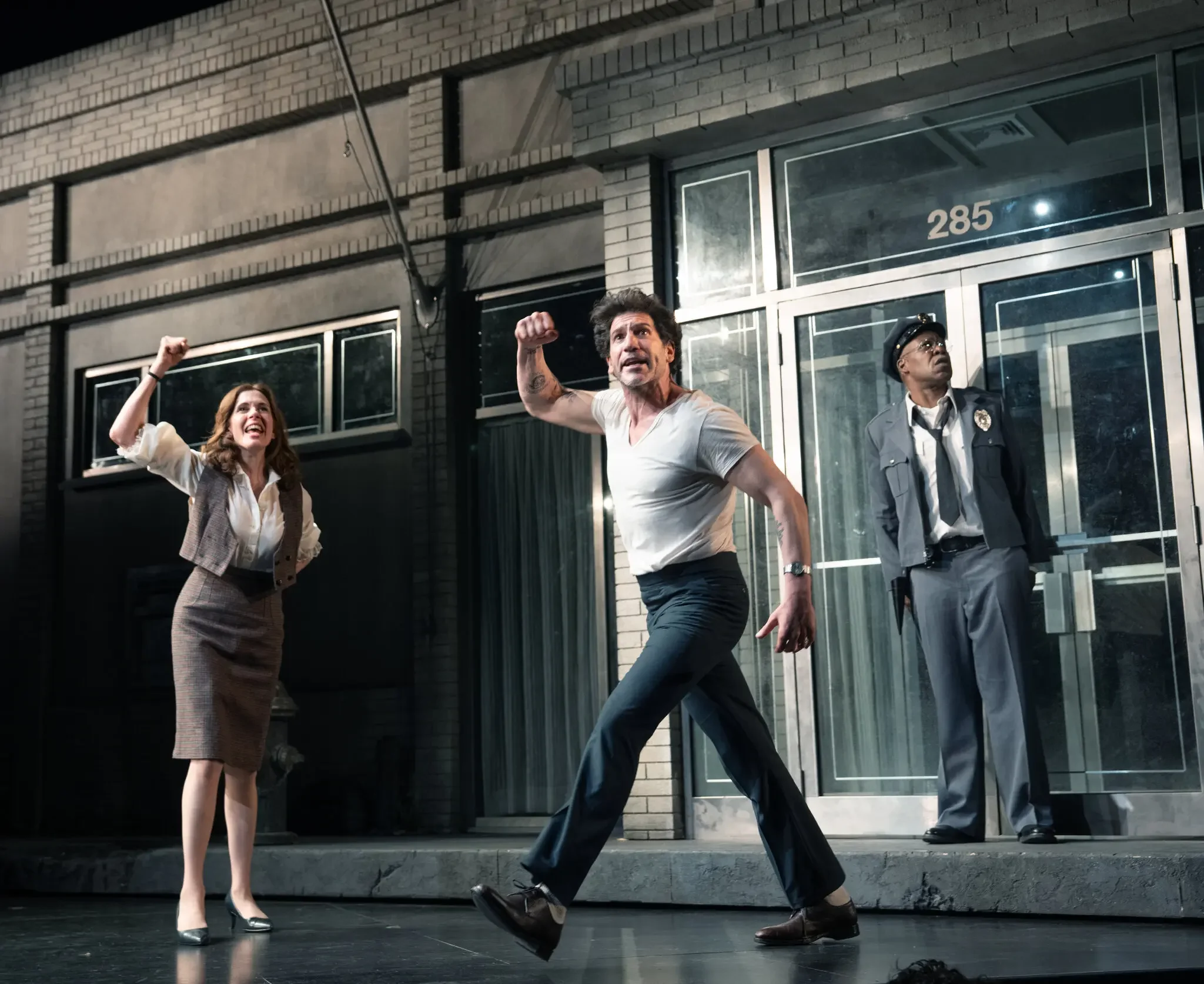
Bernthal uses that familiarity to reveal a different dimension of Sonny, one that moves away from the hardened persona audiences often associate with him and leans into something more flamboyant, more emotionally exposed, and ultimately more complicated. There is a looseness to his performance that allows the character to exist in a state of constant reaction, shifting between control and vulnerability in a way that feels particularly suited to a live setting. Rather than trying to outdo or distance himself from Pacino, he navigates the role in real time, and that tension becomes part of the experience for the audience.
Sara Krulwich
The theatricality of the performance aligns with the demands of the medium, where presence and projection carry a different kind of weight than they do on screen. Bernthal’s Sonny feels larger without losing immediacy, and the energy he generates moves through the room in a way that reinforces the live nature of the production. The audience is not simply observing the performance; it is responding to it, and that exchange adds a layer of unpredictability that distinguishes it from the film.
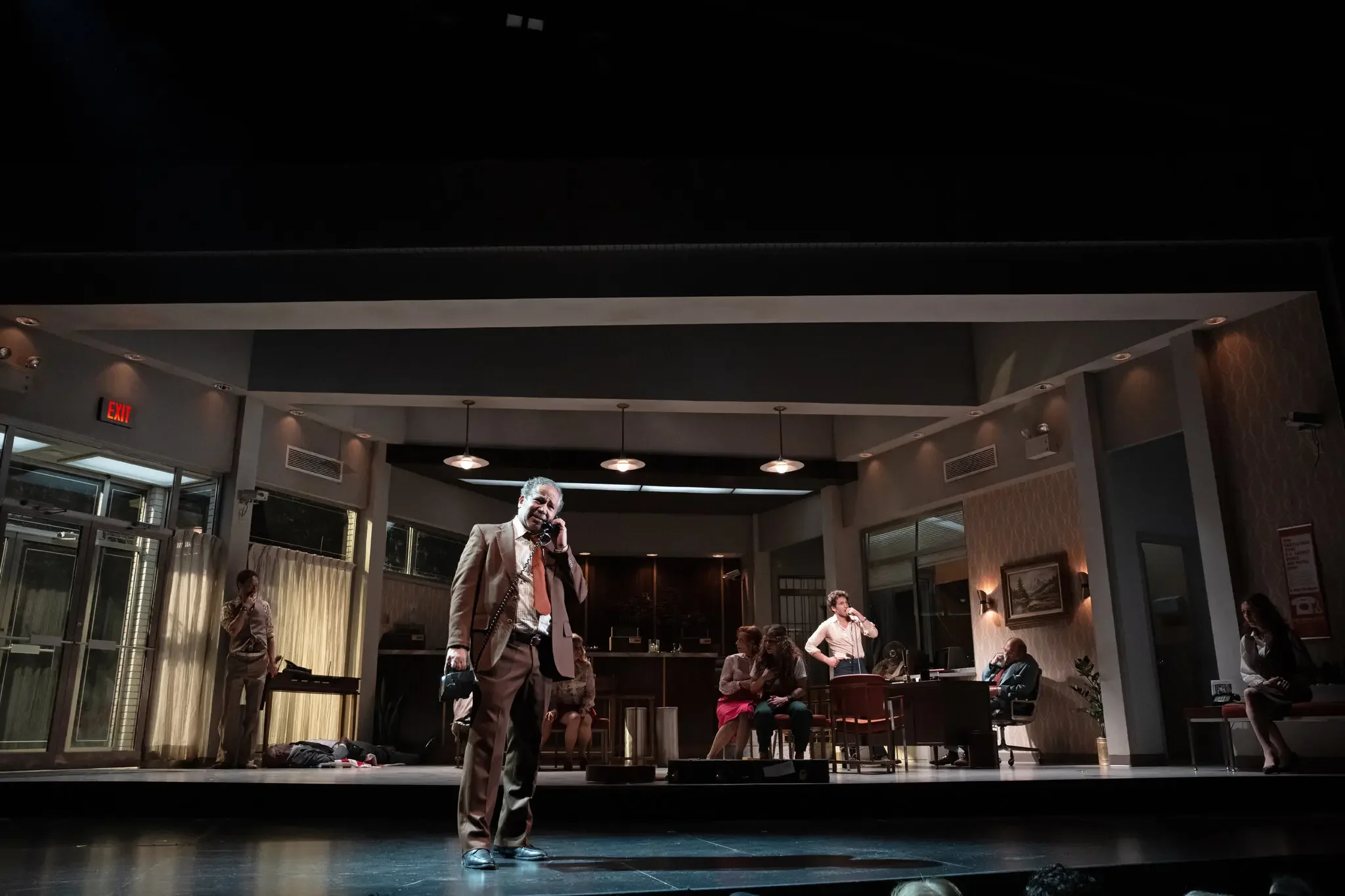
That sense of movement and perspective is echoed in the production’s staging, which stands as one of its most effective and defining elements. The rotating set does more than provide visual interest; it establishes the rhythm of the show, shifting seamlessly between the interior of the bank and the street outside while maintaining a constant sense of tension. The design allows the audience to understand the spatial dynamics of the story in a way that feels both immediate and expansive, creating a visual language that supports the narrative without attempting to replicate the film’s realism.
Sara Krulwich
By incorporating that level of physical transformation into the staging, the production is able to maintain momentum even in moments where the dialogue slows, ensuring that the tension remains present throughout. The audience is given a continuous sense of orientation within the space, which enhances the feeling of containment while simultaneously expanding the scope of what is being experienced. It is a rare example of stage design functioning as an integral part of the storytelling rather than a supporting element.
The tonal differences between the play and the film are noticeable, particularly in the way the adaptation leans more heavily into humor and theatrical expression. While the film’s strength lies in its grounded, almost documentary-like realism, the stage version adopts a more flexible rhythm that allows for moments of levity without diminishing the underlying stakes. In the context of a live performance, this approach feels less like a compromise and more like an adjustment that keeps the audience engaged while preserving the core tension of the story.
EVAN ZIMMERMAN
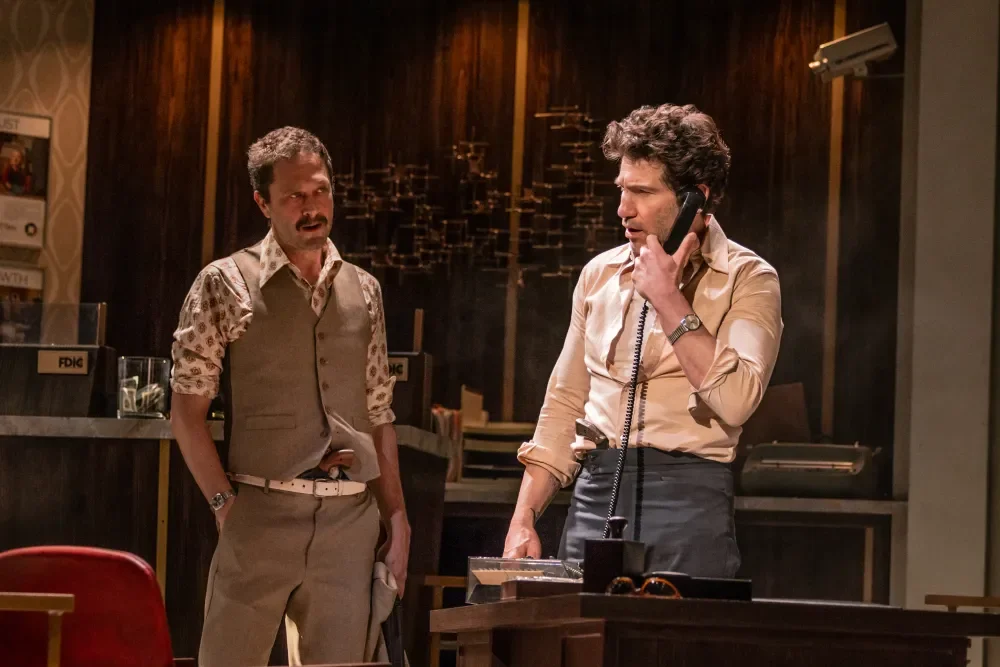
Supporting performances contribute to that balance, with Ebon Moss-Bachrach bringing a measured unpredictability to Sal that reinforces the sense of danger without overwhelming the broader tone of the production. The ensemble, particularly the bank employees, helps to create an environment that feels active and responsive, ensuring that the confined setting never becomes static or overly stylized.
POPULAR ON THE CINEMA GROUP
Comparisons to the film are inevitable, but they are ultimately limited in their usefulness. The play does not attempt to replicate the haunting quality of Lumet’s direction or Pacino’s singular performance, and it does not need to in order to justify its existence. What it offers instead is a different way of experiencing the same story, one that emphasizes immediacy, spatial awareness, and the dynamic relationship between performer and audience.
That distinction is where the production succeeds. It understands that it is operating within a different medium and makes choices that reflect that reality, allowing the material to function on its own terms rather than as a direct extension of the film. In doing so, it creates an experience that feels present, reactive, and fully alive in the moment, which is ultimately what theater is meant to do.
Rating: ★★★★☆
That’s a Wrap
|
Dog Day Afternoon
|
That’s a Wrap | Dog Day Afternoon |
“Jon Bernthal leans into Pacino and comes out with something of his own, anchored by a rotating set that turns a classic into a live-wire experience worth seeing in the room.”
CREDITS
Venue: August Wilson Theater, New York
Cast: Jon Bernthal, Ebon Moss-Bachrach, Jessica Hecht, John Ortiz
Director: Rupert Goold
Writer: Stephen Adly Guirgis
Set design: David Korins
Costume design: Brenda Abbandandolo
Lighting design: Isabella Byrd
Sound design: Cody Spencer

| FEATURES | INTERVIEWS | REVIEWS | The Catalogue | TRENDING | TRAILERS | VIDEOS |









![WERWULF - Official Trailer [HD] - Only In Theaters Christmas](https://i.ytimg.com/vi/cmjpadVj-Vk/hqdefault.jpg)